






Access Live RabbitMQ Data in Tableau with CData API Server

Tableau is one of the leading BI platforms for connecting, visualizing, and sharing data insights.
With the CData API Server and the RabbitMQ Connector (or any of the 270+ available), you can quickly create APIs that expose live data from multiple sources, using industry standards like OData and Swagger for seamless integration with Tableau.
In this article, we'll create a simple Tableau dashboard with live data from RabbitMQ, without moving or replicating data.
Let's get started!
Prerequisites
- CData API Server: Download a free trial here.
- Tableau: Sign in, sign up, or download from here.
- An active RabbitMQ account with access to your data.
Overview
Here's a quick overview of the steps we'll follow:
- Install the CData API Server, configure a connection to RabbitMQ, and use the OData endpoints.
- Connect to these endpoints in Tableau to build live dashboards and reports.
Step 1: Install the API Server and Add a Connection to RabbitMQ
1.1 Install the API Server
If you haven't already, download an installer for your machine from the CData API Server page. Follow the installation instruction to complete the setup.
Once installed, you can start the server in the following ways:
- Windows: CData API Server runs as a service by default. Make sure the service is running, then open the http://hostname:port (e.g., http://localhost:8080/) in your browser to access the API Server admin console.
- Linux/Mac: You can run the server manually or as a service. To start it manually, navigate to the installation directory and run java -jar apiserver.jar.
- Alternatively, run service.sh with root privileges to set up API Server as a Linux system service.
1.2 Enable CORS
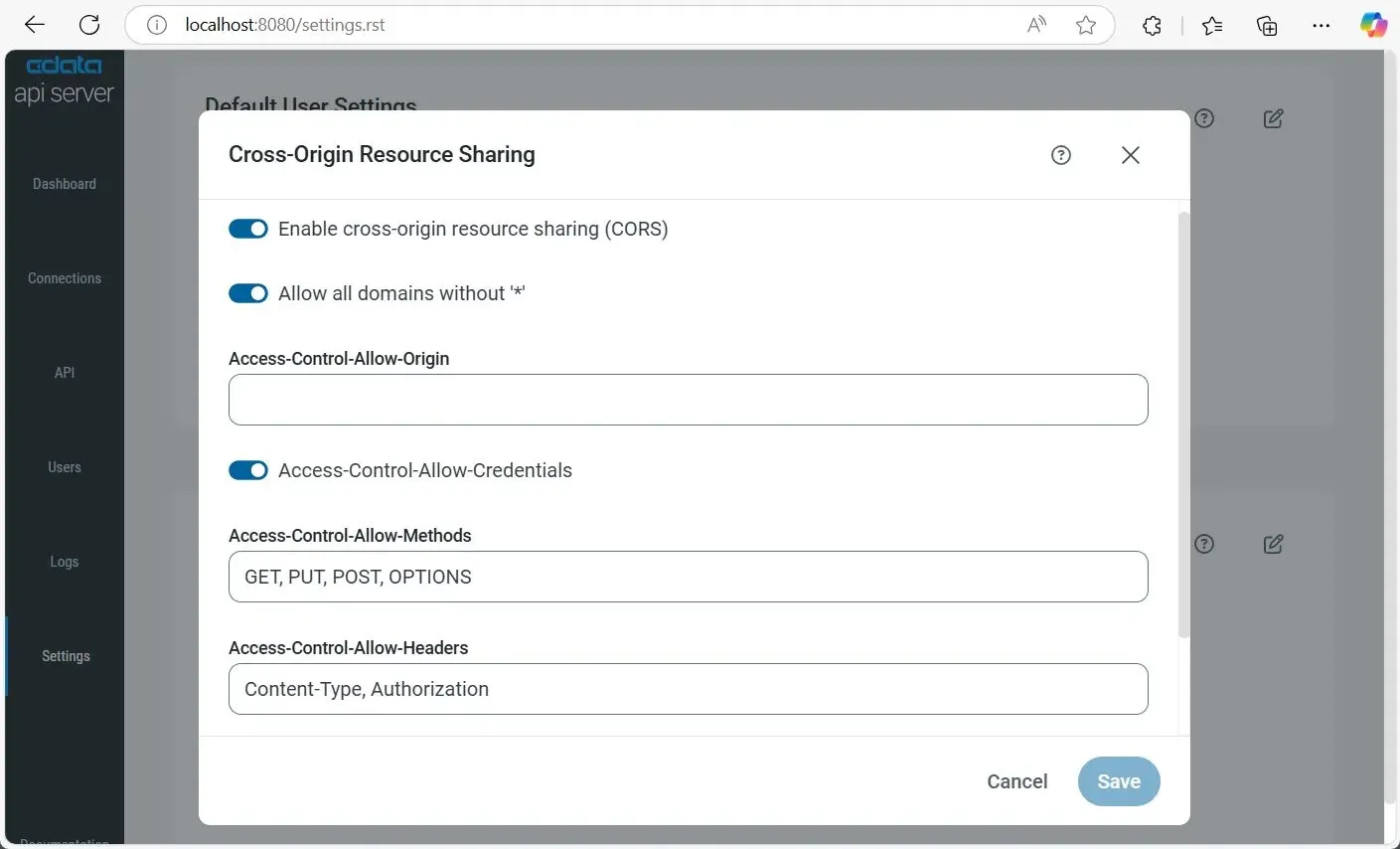
When Tableau and the CData API Server are hosted on different domains, CORS (Cross-Origin Resource Sharing) must be enabled to allow Tableau to access the data endpoints. To enable CORS in the API Server:
- Go to Settings and click the icon to edit CORS settings.
- Enable Cross-Origin Resource Sharing (CORS).
- Enable Allow all domains without '*' to accept any origin.
- In Access-Control-Allow-Origin, enter your Tableau origin domain, or use * to allow all domains (suitable for public APIs).
- Enable Access-Control-Allow-Credentials to allow cookies and auth headers.
- In Access-Control-Allow-Methods, enter GET, PUT, POST, OPTIONS.
- In Access-Control-Allow-Headers, enter Authorization, Content-Type.
- Set Access-Control-Max-Age (default: 3600 seconds) to cache preflight requests.
- Click Save.
1.3 Add a RabbitMQ Connection in the API Server
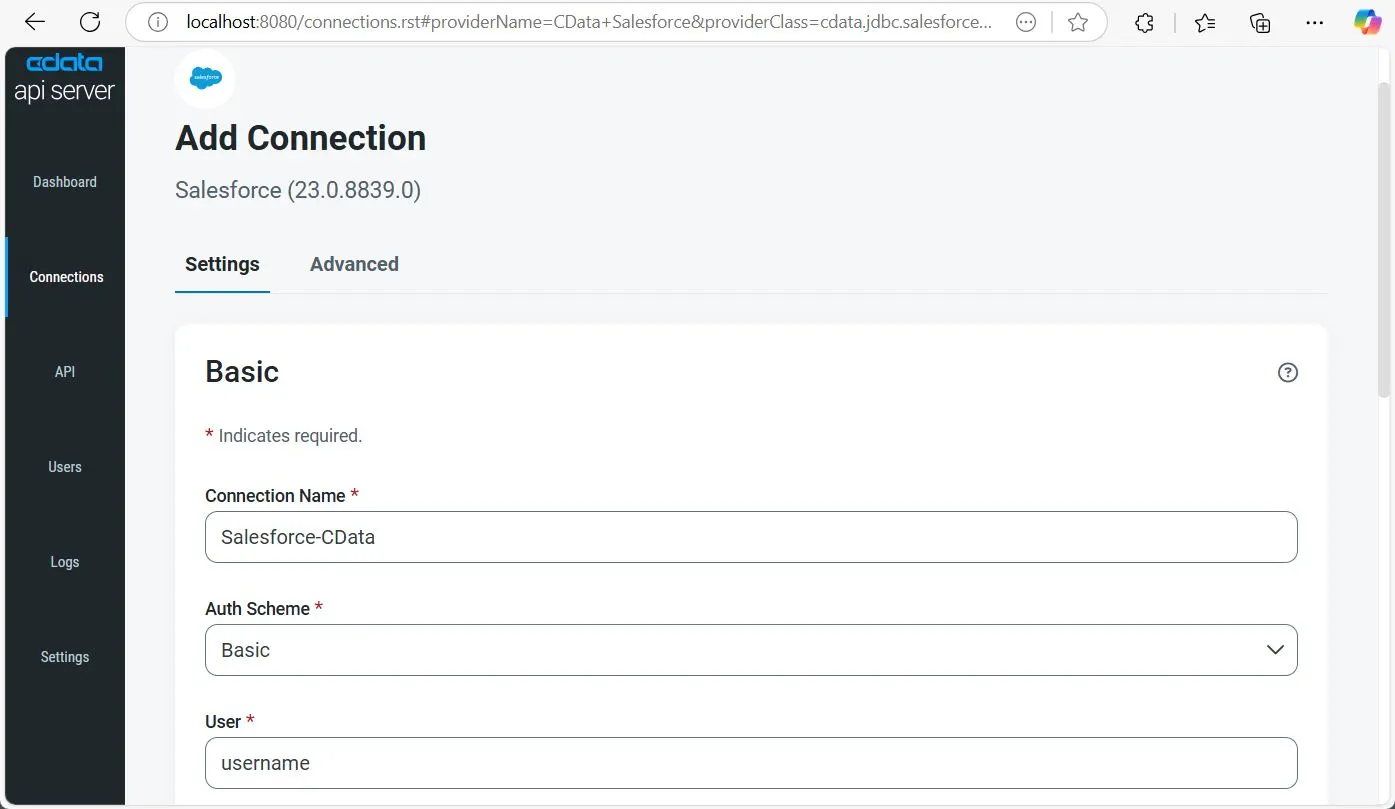
- Go to Settings and click Add Connection in the top-right.
- Select RabbitMQ. If it's not visible, toggle off Only Installed to view all connectors.
- Click Install Connector to auto-install. For a manual setup, choose Manual Install and upload the downloaded ZIP file.
- Once installed, click RabbitMQ again to open its connection settings and configure using the details below.
- Ensure the RabbitMQ Management plugin is enabled on your server (rabbitmq-plugins enable rabbitmq_management).
- Use an existing management user or create one with the appropriate management tag (management, policymaker, monitoring, or administrator).
- Note the full base URL of your RabbitMQ Management HTTP API (e.g., http://localhost:15672).
- AuthScheme: Set this to Basic.
- URL: Set this to the base URL of your RabbitMQ Management HTTP API (e.g., http://localhost:15672).
- User: Set this to your RabbitMQ management username (e.g., guest).
- Password: Set this to your RabbitMQ management password.
- Overview - Cluster-wide statistics and information about the RabbitMQ node
- Nodes - Information about individual nodes in the RabbitMQ cluster
- NodeMemory - Detailed memory usage breakdown for a specific cluster node
- Connections - List of all open AMQP connections to the broker
- Channels - List of all open AMQP channels across all connections
- Consumers - List of all consumers registered across all queues
- Exchanges - List of exchanges declared across all virtual hosts
- Queues - List of queues declared across all virtual hosts
- Bindings - List of all bindings between exchanges and queues
- VirtualHosts - List of virtual hosts configured on the broker
- VhostPermissions - User permissions within a specific virtual host
- Users - List of all RabbitMQ users
- Permissions - Permission records for all users across all virtual hosts
- TopicPermissions - Topic-level permission records for all users
- Policies - List of policies applied to queues and exchanges in virtual hosts
- OperatorPolicies - List of operator policies applied to queues in virtual hosts
- Parameters - List of component parameters (e.g., federation, shovel) per virtual host
- GlobalParameters - List of global parameters that apply across all virtual hosts
- VhostLimits - Resource limits configured for specific virtual hosts
- UserLimits - Resource limits configured for specific users
- FeatureFlags - List of feature flags and their enabled/disabled state on the node
- DeprecatedFeatures - List of deprecated features and their usage state
- AuthAttempts - Authentication attempt statistics for the node
- ClusterName - The name of the RabbitMQ cluster
- WhoAmI - Information about the currently authenticated management user
- ExchangeBindingsSource - Bindings for which a specific exchange is the source
- ExchangeBindingsDestination - Bindings for which a specific exchange is the destination
- QueueBindings - Bindings for a specific queue within a virtual host
- Click Save & Test to validate and complete the connection setup.
About RabbitMQ Management HTTP API
RabbitMQ is an open-source message broker that supports multiple messaging protocols. The RabbitMQ Management HTTP API provides HTTP-based access to management and monitoring data for a RabbitMQ server. The API exposes information about virtual hosts, exchanges, queues, bindings, connections, channels, consumers, users, permissions, policies, and cluster-wide statistics.
The Management plugin must be enabled on the RabbitMQ server for the HTTP API to be available. By default, the management interface listens on port 15672.
Using Basic Authentication
RabbitMQ Management HTTP API uses HTTP Basic authentication. You must supply the username and password of a RabbitMQ management user.
To enable access to the management API:
After configuring your RabbitMQ server, set the following connection properties to connect:
Example connection string:
Profile=C:\profiles\RabbitMQ.apip;AuthScheme=Basic;URL=http://localhost:15672;User=guest;Password=guest;
Available Tables
The RabbitMQ profile provides access to the following tables:
1.4 Add and Configure Users
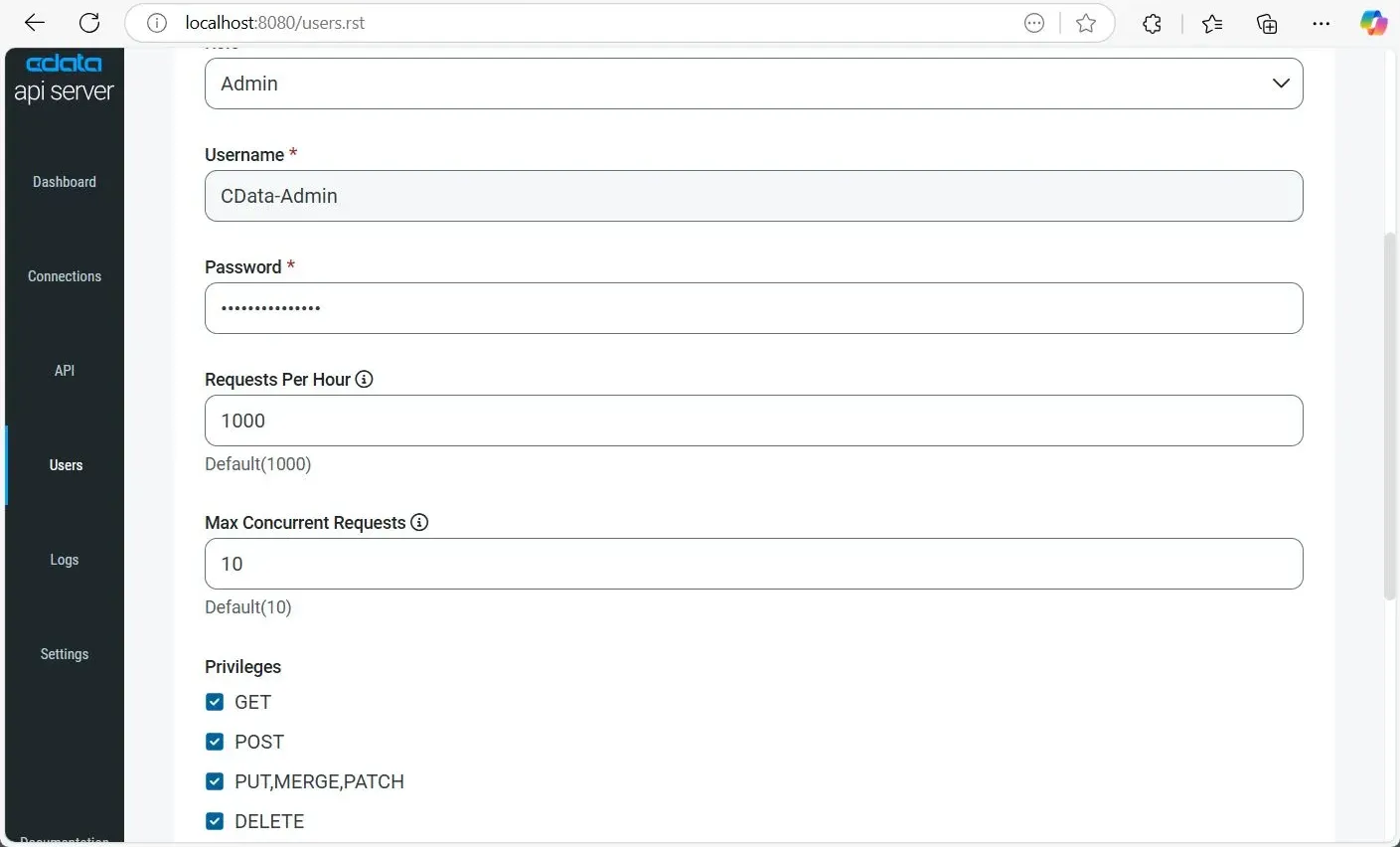
To allow secure access to the created OData endpoints, create and configure Users in the CData API Server. Each user has authentication credentials and role-based access control, ensuring that only authorized users with appropriate roles can query the connected data.
- Go to Users from the navigation pane, then click Add User in the top-right corner.
- Enter a Username and set a secure Password for the user.
- Select a Role:
- Admin: Full access to all features, including settings and connections.
- Query: Limited to data access via API endpoints (suitable for Tableau use).
- (Optional) Configure rate limits:
- Requests Per Hour: Number of allowed API calls per hour (default: 1000).
- Max Concurrent Requests: Number of parallel API requests allowed (default: 10).
- Define Privileges for the user:
- GET: Allows data retrieval.
- POST: Allows creation of new records.
- PUT, MERGE, PATCH: Allows updates to existing records.
- DELETE: Allows deletion of records.
- Click Add User to save and activate the user account.
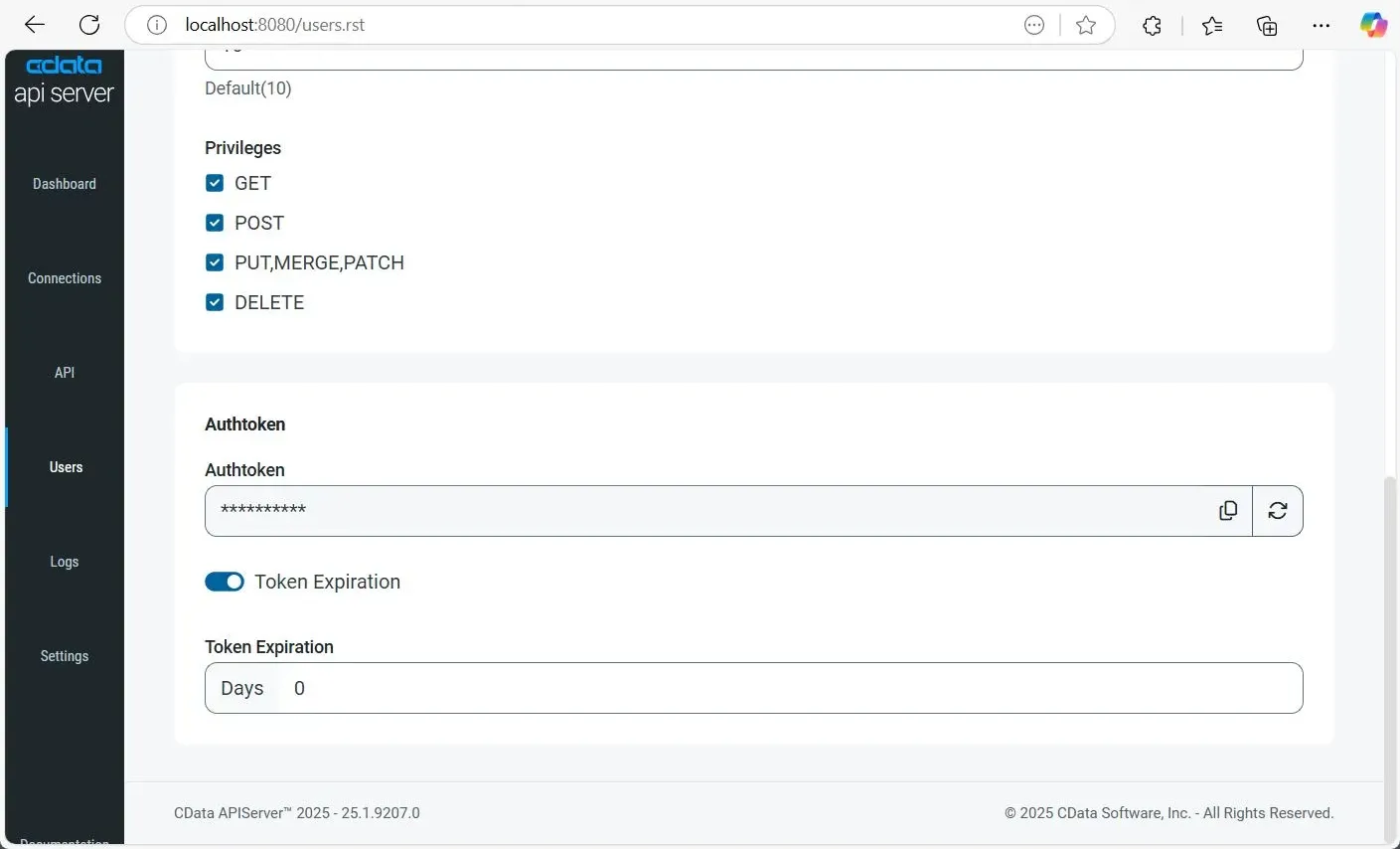
Once a user is added, an Authtoken is automatically generated. This token can be used in API requests as a secure authentication method instead of a password.
You can also refresh the Authtoken, disable it, or set expiration rules (e.g., number of days until expiry) by enabling the Token Expiration option in the user settings.
1.5 Add Tables for the Endpoint
To make data from RabbitMQ available in Tableau via OData, you need to expose your desired tables through the API Server. Here's how:
- In the CData API Server, go to API from the left navigation, then click Add Table at the top-right.
- Select the RabbitMQ connection you configured earlier, then click Next.
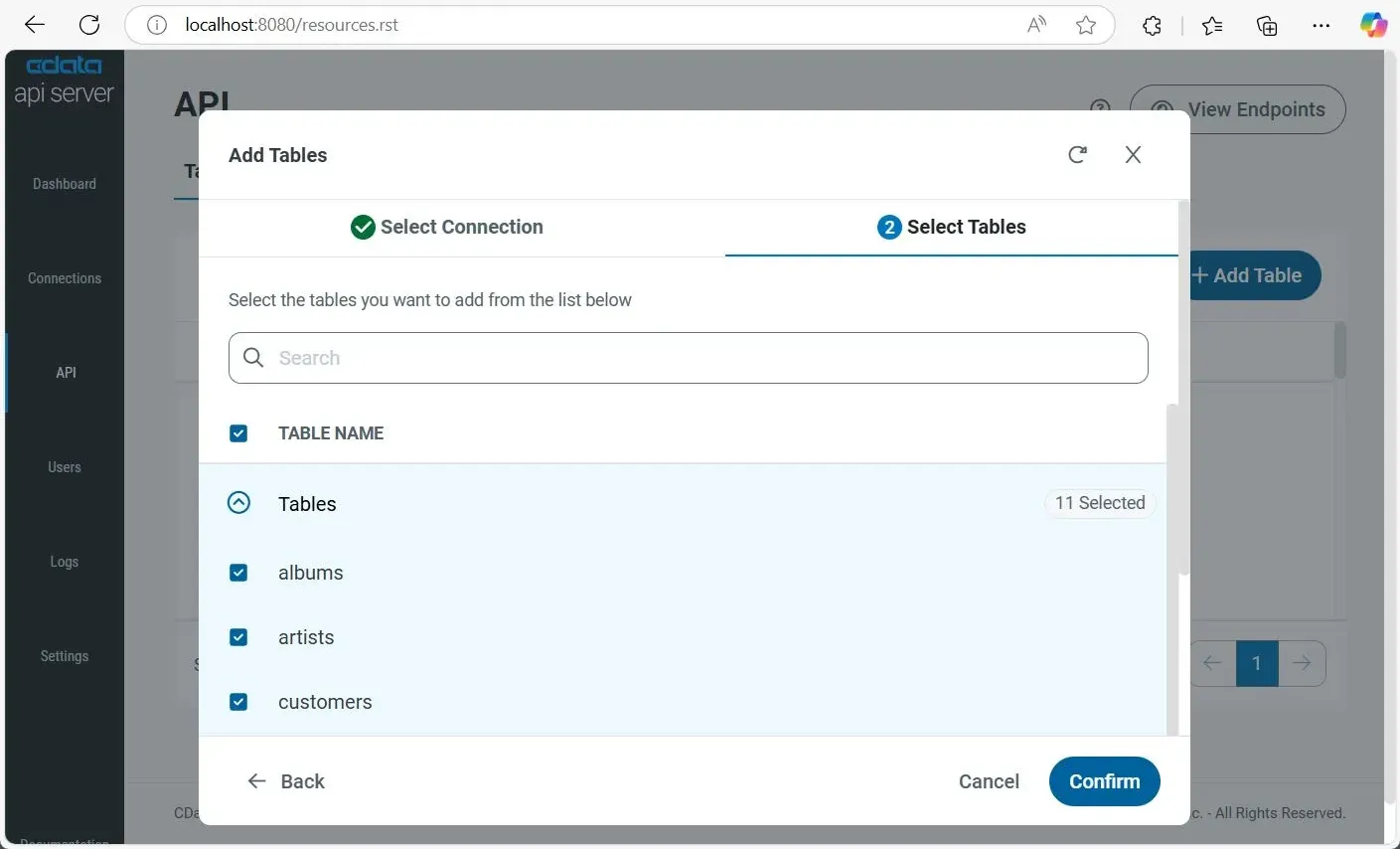
- Browse available entities and schema by expanding the Tables section. Select individual tables, or click the TABLE NAME checkbox at the top to select all. Then click Confirm.
1.6 Access the Endpoints in Tableau
Now that your API is configured, you can connect Tableau directly to the OData endpoints to visualize live data. Below are the URL formats for the OData endpoints:
| Endpoint | URL | |
|---|---|---|
| Entity List | http://address:port/api.rsc/ | |
| Table Metadata (e.g., albums) | http://address:port/api.rsc/albums/$metadata?@json | |
| Table Data (e.g., albums) | http://address:port/api.rsc/albums |
These OData endpoints can now be connected to Tableau to create live dashboards, charts, and reports.
The CData API Server supports full OData filtering capabilities (OData ABNF). For refined queries, you can append standard OData query parameters like $select, $filter, $orderby, $top, and $skip to the requests.
Step 2: Create a Simple Dashboard in Tableau
With your CData API Server exposing OData endpoints for RabbitMQ data, you can now connect Tableau to the API and build a real-time dashboard. Here's how to do it.
For this article, we'll use Tableau Desktop on Windows, but the steps should work with all Tableau versions.
2.1. Connect to the OData Endpoint
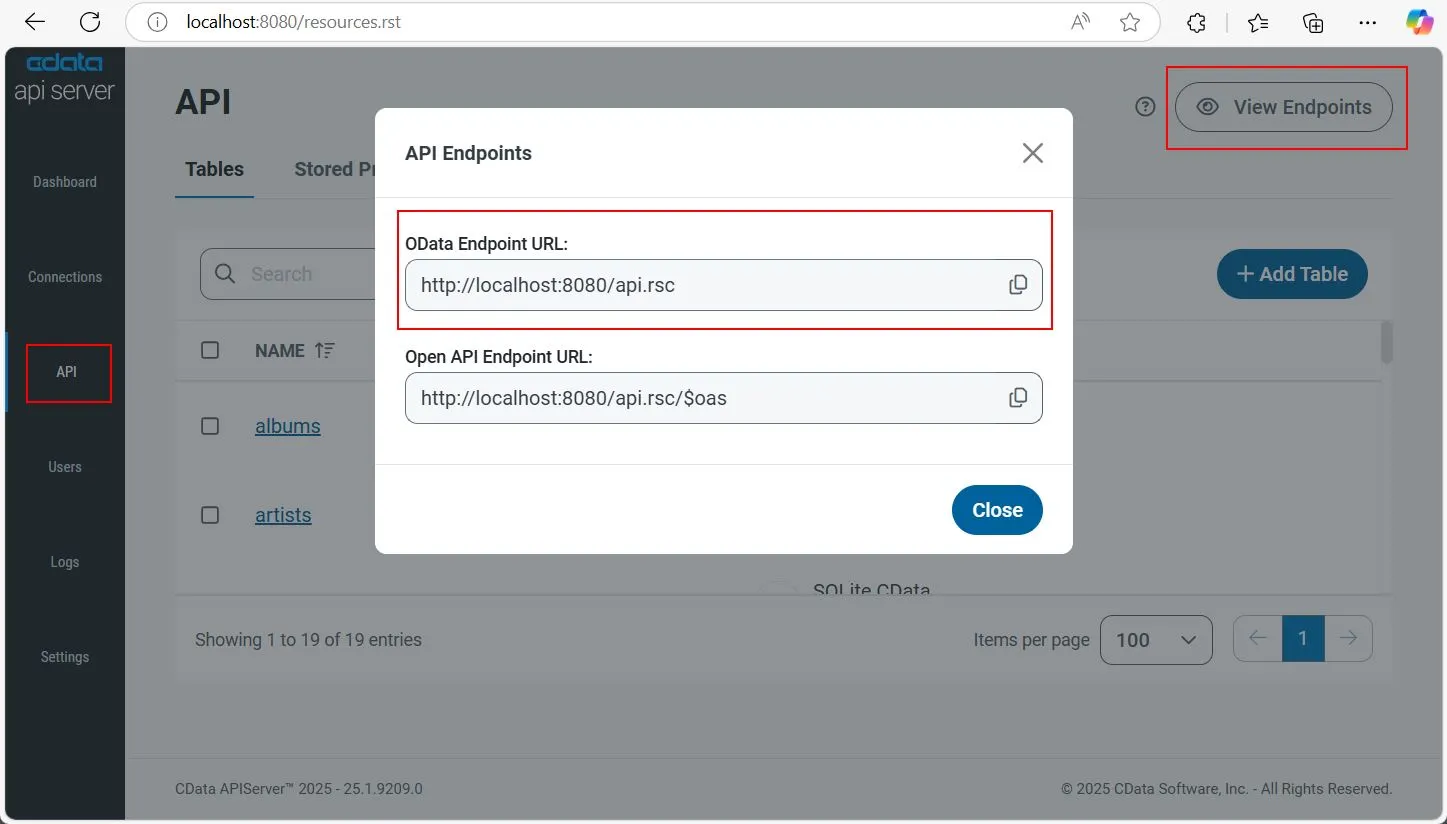
- Get the CData API Endpoint URL by logging into your CData API Server. Go to API from the left navigation, then click View Endpoints at the top-right.
- Copy the URL (e.g., http://localhost:8080/api.rsc).
- Launch Tableau and log in to your account.
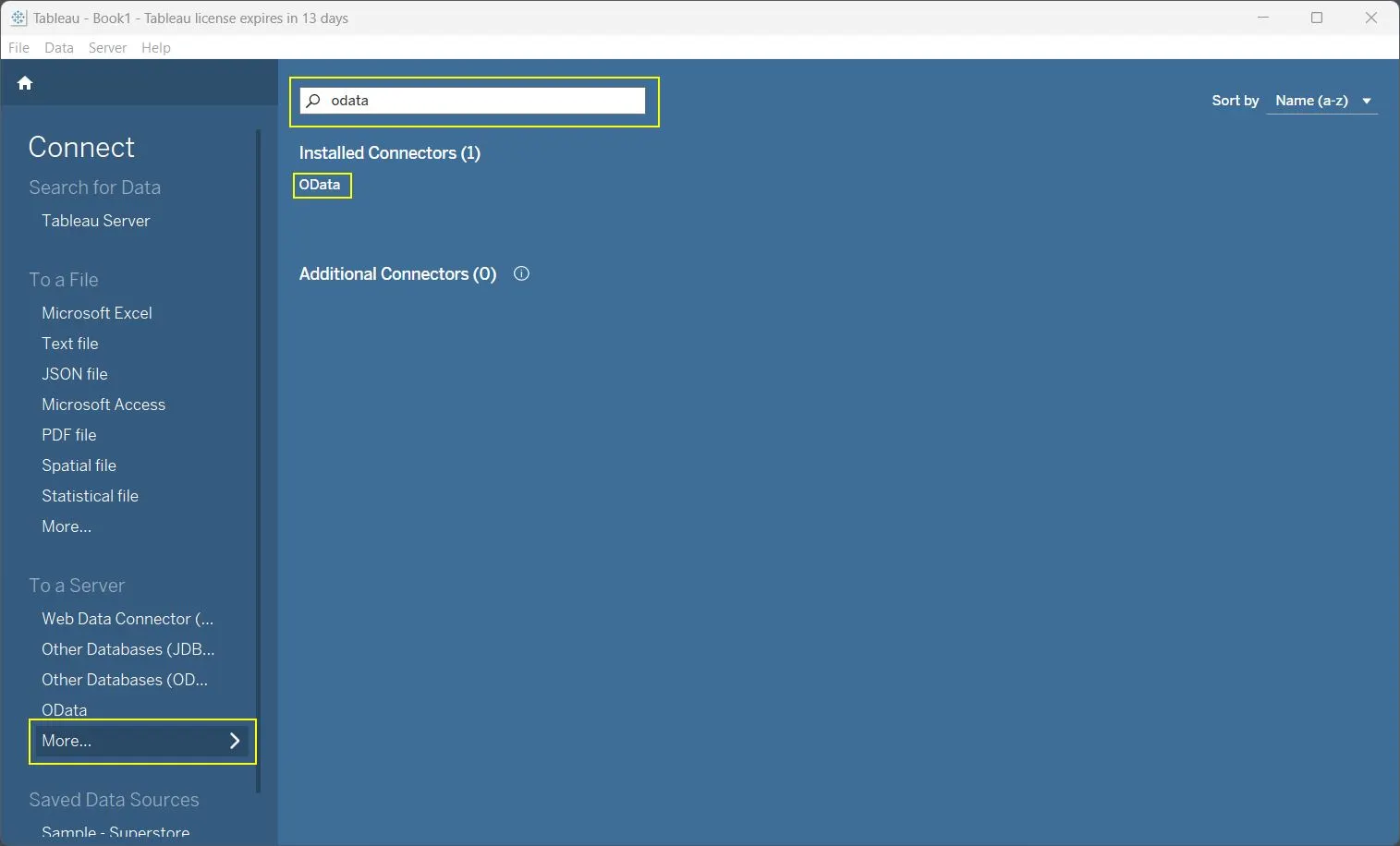
- On the left under To a Server, click More, then search for OData and select it.
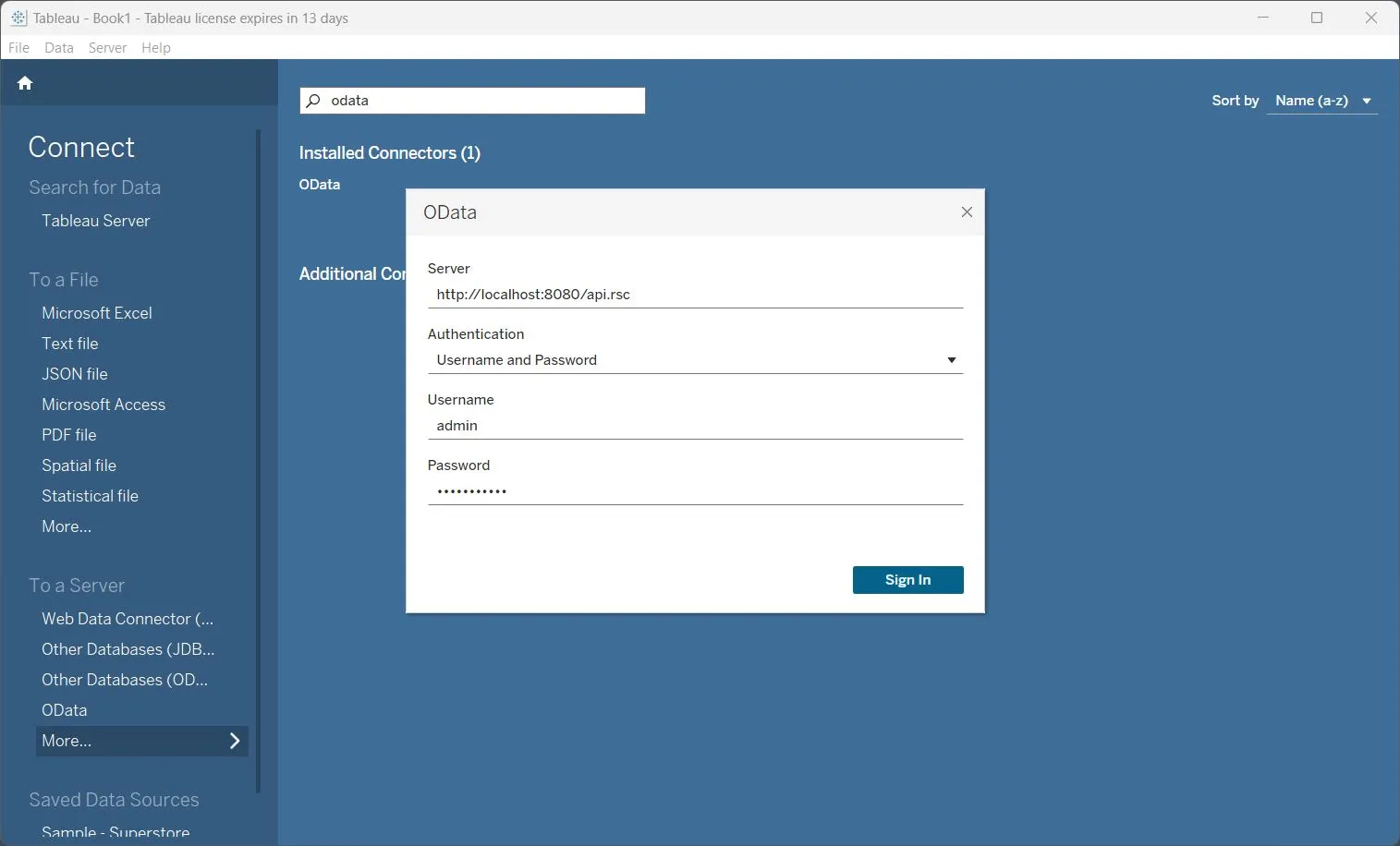
- Add the following details:
- Server: Your CData API Server Endpoint URL (e.g., http://localhost:8080/api.rsc)
- Authentication: Select Username and Password.
- Username: Enter your CData Server API Username.
- Password: Enter your CData API Server Password.
2.2. Create a Dashboard
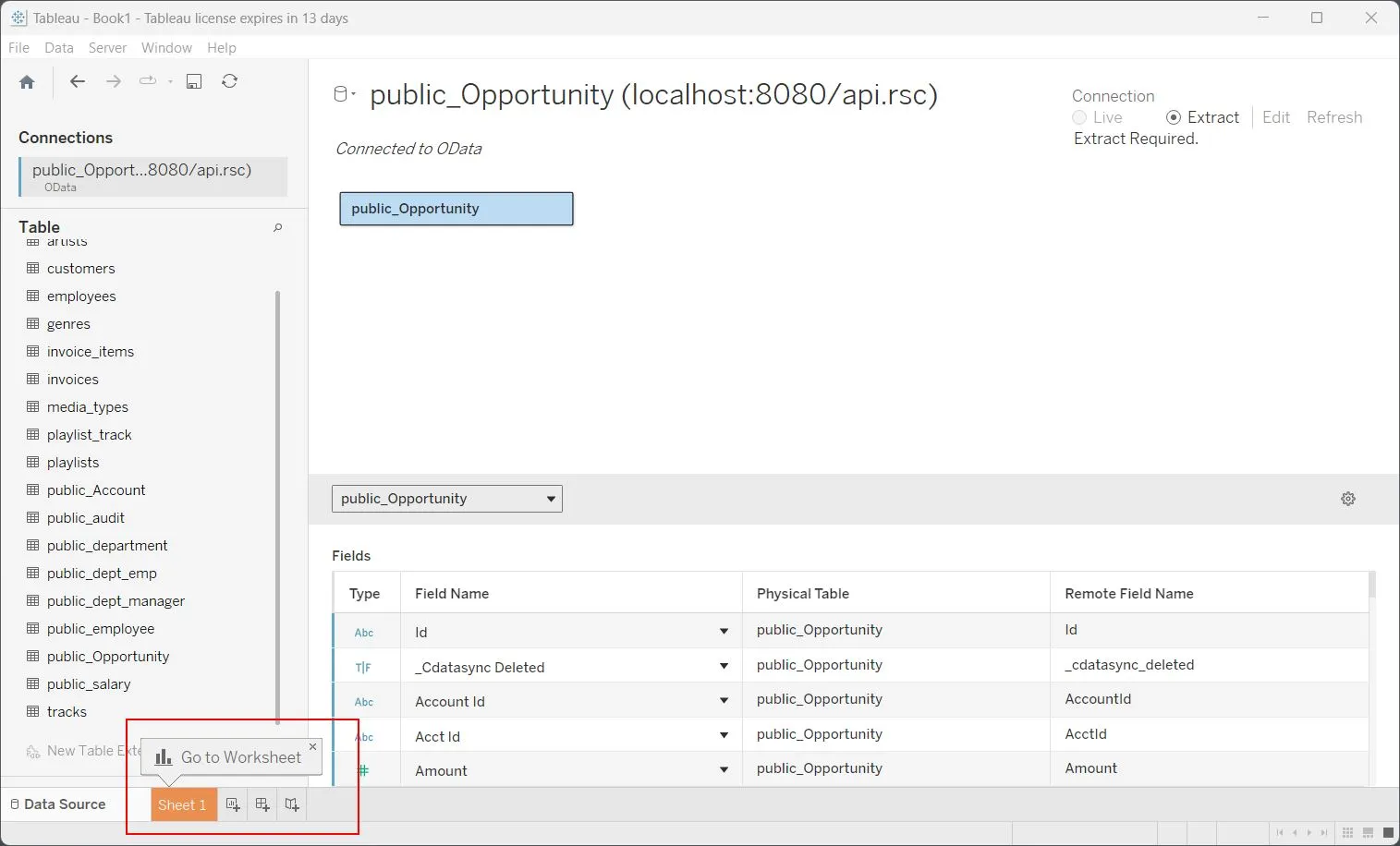
- On the left under Tables, drag your desired table to the canvas, then click on Sheet 1 at the bottom left.
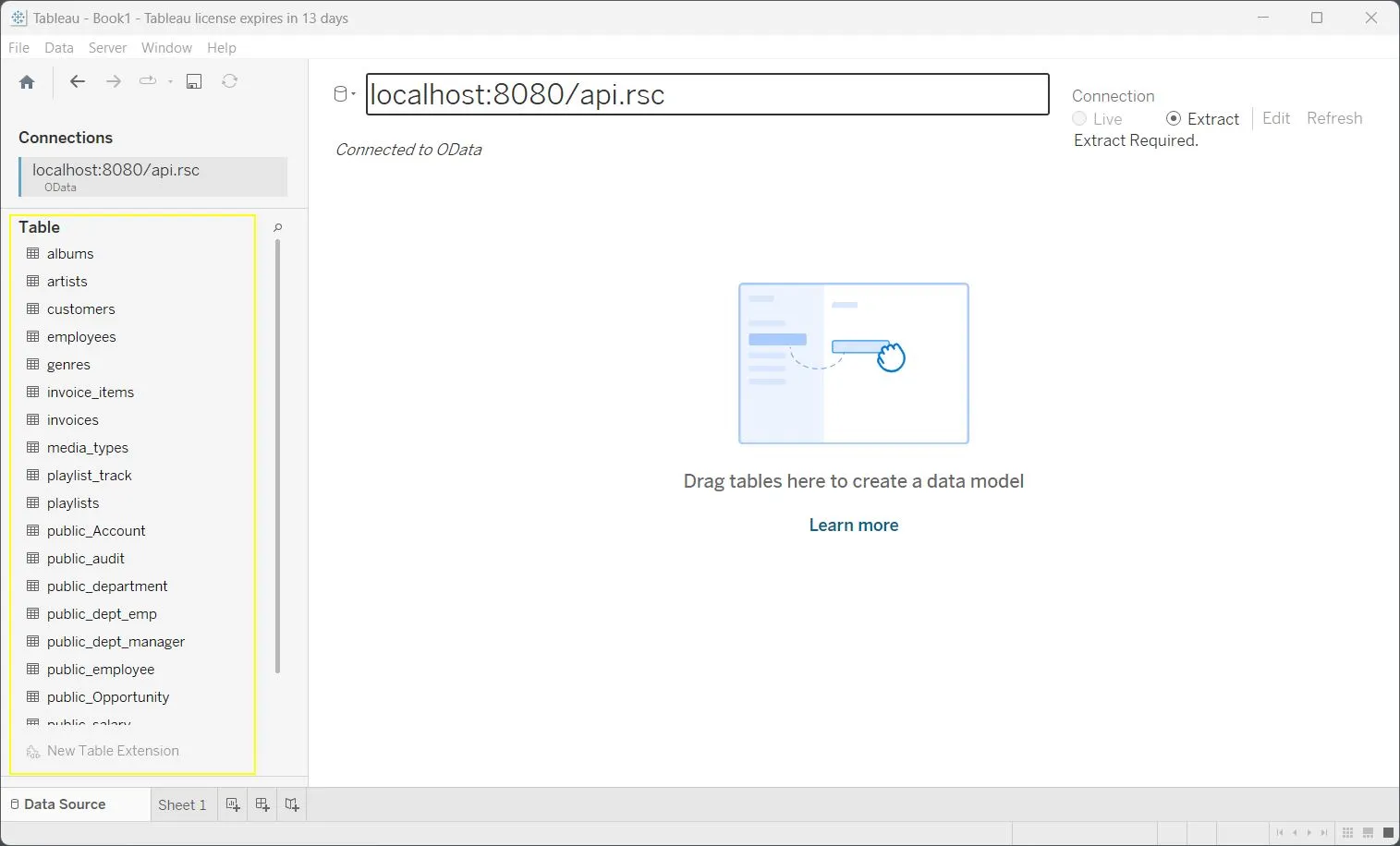
- In Sheet 1, on the left under Tables, double-click your desired columns from the selected table to add them to the view.
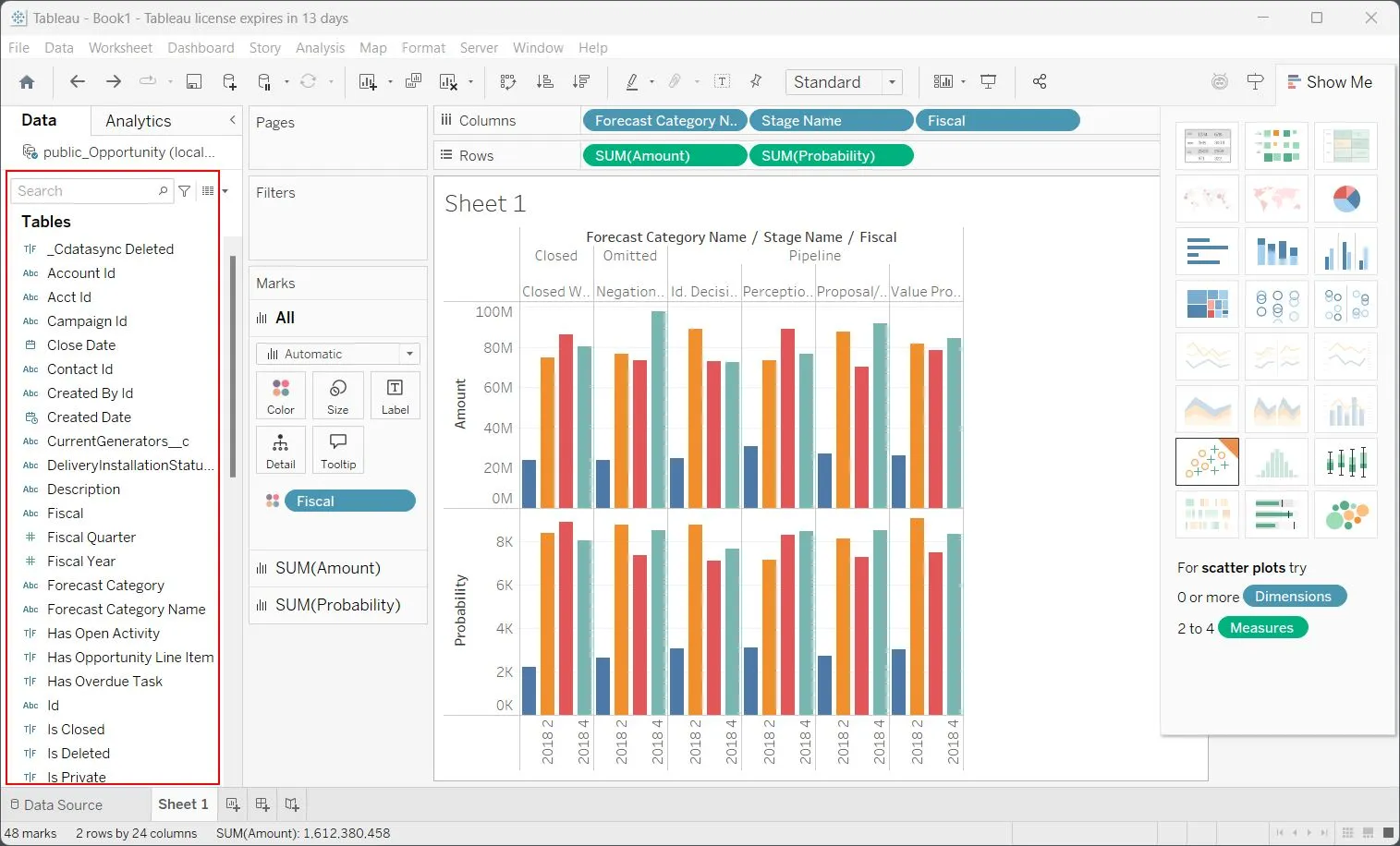
- Drag and drop columns into the Columns and Rows sections at the top to create a visualization. In this example, we have created a simple forecasting bar chart.
2.3. Refine Your Dashboard
Continue refining your dashboard by adding filters, formatting, and combining multiple sheets. You can create more complex visualizations and interactive dashboards based on your live API data.
Try CData API Server Free for 30 Days
Build OData REST APIs with a low-code/no-code platform and unlock seamless integration with your live data. Try CData API Server free for 30 days and experience how easily you can connect live RabbitMQ data (or any of the 270+ available connectors) directly into Tableau for real-time dashboards and analytics.