








The MCP platform advantage
Native MCP servers wire one source to one tool. A platform connects everything to everything, governed in one place.
Native MCP servers offer a quick solution—and a growing liability
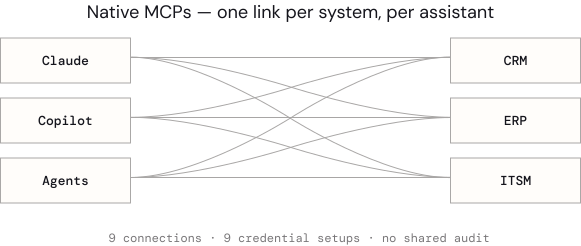
A native MCP server is a single connection
Every native or built-in-house MCP server you adopt adds another connection to run: another auth model to configure, another audit surface to watch, another integration that breaks on the vendor's schedule.
An MCP platform is a single data layer
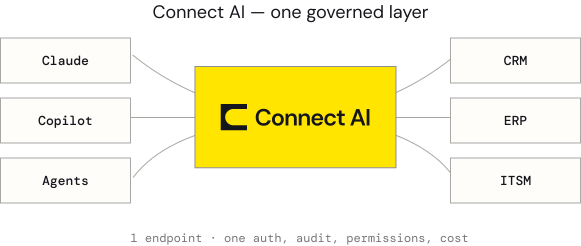
A data layer gives AI governed access to all sources, with definitions and context intact—one authentication model, one audit log, one place to set permissions, one place to manage costs.
What will it cost to run your AI program in 12 months?
A single-source MCP server is seemingly free. But as your program scales, four cost drivers grow exponentially. Avoid them by choosing CData as your data layer.
Read the build vs. buy analysisCredentials, governance, and audit logging are configured separately for every source.
Context is defined inside each server—no shared definitions, so answers drift across sources.
Every vendor API change lands on your team's maintenance queue.
Every native MCP returns raw data dumps, and token spend compounds as usage grows.
Every hour spent running connections is an hour not spent on the AI program itself.
CData is the data layer for an AI program that scales
A successful AI program never needs fewer sources, and single-connection costs only compound. CData Connect AI lets you grow and be in control.
One endpoint
Native MCPs add a server per source; a platform puts hundreds of sources, cloud or on-prem, behind one endpoint added by configuration.
Explore the capabilityZero maintenance
Native MCPs break on each vendor's schedule and you own the fix; the platform keeps connections, credentials, and tokens current.
Explore the capabilityNo lock-in
Native MCPs wire each tool to each source; the platform is neutral, so you swap models or assistants without re-wiring the data layer.
Explore the capabilitySemantic intelligence
Native MCPs ship raw schemas and leave interpretation to the model; the platform embeds deep API knowledge and connector-specific instructions that teach the model how each system works—cutting tool calls and tokens.
Explore the capabilityDefined data views
A native MCP exposes whatever its source exposes; the platform lets you specify exactly which datasets, schemas, and views AI can see—as cross-source virtualized datasets.
Explore the capabilityCurated toolkits
Native MCPs give AI only the tools the vendor shipped; the platform layers universal, source, and custom tools into precisely scoped toolkits—agents get exactly the context they need, nothing more.
Explore the capabilityPolicy at the layer
Native MCPs pass through whatever the source allows; the platform enforces RBAC, ABAC, row-level rules, and PII masking with no source changes.
Explore the capabilityScoped access
Native MCPs inherit the user's full source permissions; the platform downscopes AI access and gates write actions by agent, source, and workflow.
Explore the capabilityOne audit log
Native MCPs log tool calls per source, if at all; the platform logs query, identity, tokens, and policy decisions in one place.
Explore the capabilityIf you run it, we can connect to it
Connect any MCP-enabled AI client to any database, on-prem system, or SaaS app.


Can you answer these questions about your AI infrastructure?
Connectivity
Your team stops running connections and starts running the program.

Context
Your AI gets accurate answers with fewer tokens.

Control
Governance is enforced before data ever reaches the model.

Single-source MCPs vs. a managed MCP platform
The build-vs-buy decision in depth: the context, control, and connectivity gaps; total cost of ownership; and governance at the data layer. Written for the architect who has to make the case internally.