Anthropic's launch of Claude Managed Agents (Claude Managed Agents overview) should have been one of the more important platform announcements of the year. Instead, it landed in the shadow of a flashier release: Claude Mythos Preview, a tightly controlled research preview of their next generation model that basically blew away all the benchmarks. Currently Mythos is focused on advanced cybersecurity capability, alongside Anthropic's Project Glasswing work on finding and fixing vulnerabilities in open-source software.
That is understandable. Claude Mythos raises obvious questions about frontier capability, safety, and misuse. But Claude Managed Agents may end up mattering more for everyday Agentic builders. It is Anthropic's attempt to productize a hard-won lesson from the last year of agent engineering: the model is only part of the system. The rest of the value comes from the harness around it.
This blog looks at what Claude Managed Agents actually is, where it fits in the agent stack, why enterprises may find it attractive, and where the trade-offs begin.
What is Claude Managed Agents?
At a high level, Claude Managed Agents is a fully managed agent harness. Anthropic describes it as a hosted service that runs long-horizon agents on your behalf through stable interfaces, with stateful sessions, persistent event history, secure sandboxing, built-in tools, and server-sent event streaming. Rather than forcing every team to hand-roll the agent loop, session management, sandboxing, tool routing, and infrastructure plumbing, Anthropic exposes those pieces as managed platform primitives.
These primitives are decoupled enough that they can vary independently, and consequently, fail and recover independently. In Anthropic's own framing, the goal is to decouple the “brain” from the “hands.” The brain is the model plus the harness that decides what to do next. The hands are the tools, sandboxes, and external systems that actually execute work. Anthropic's argument is that these harnesses keep going stale as models improve, so the most durable product is not a fixed harness implementation but a meta-harness: a stable interface around a harness that Anthropic can keep evolving underneath.
You define an agent once as a reusable, versioned resource. Anthropic's docs say an agent bundles the model, system prompt, tools, MCP servers, and skills that shape how Claude behaves in a session. You can prototype visually in Console or define and version agents programmatically via the API and Anthropic's new ant CLI, which can keep resources like agents, skills, environments, and deployments in sync as YAML files in a repository.
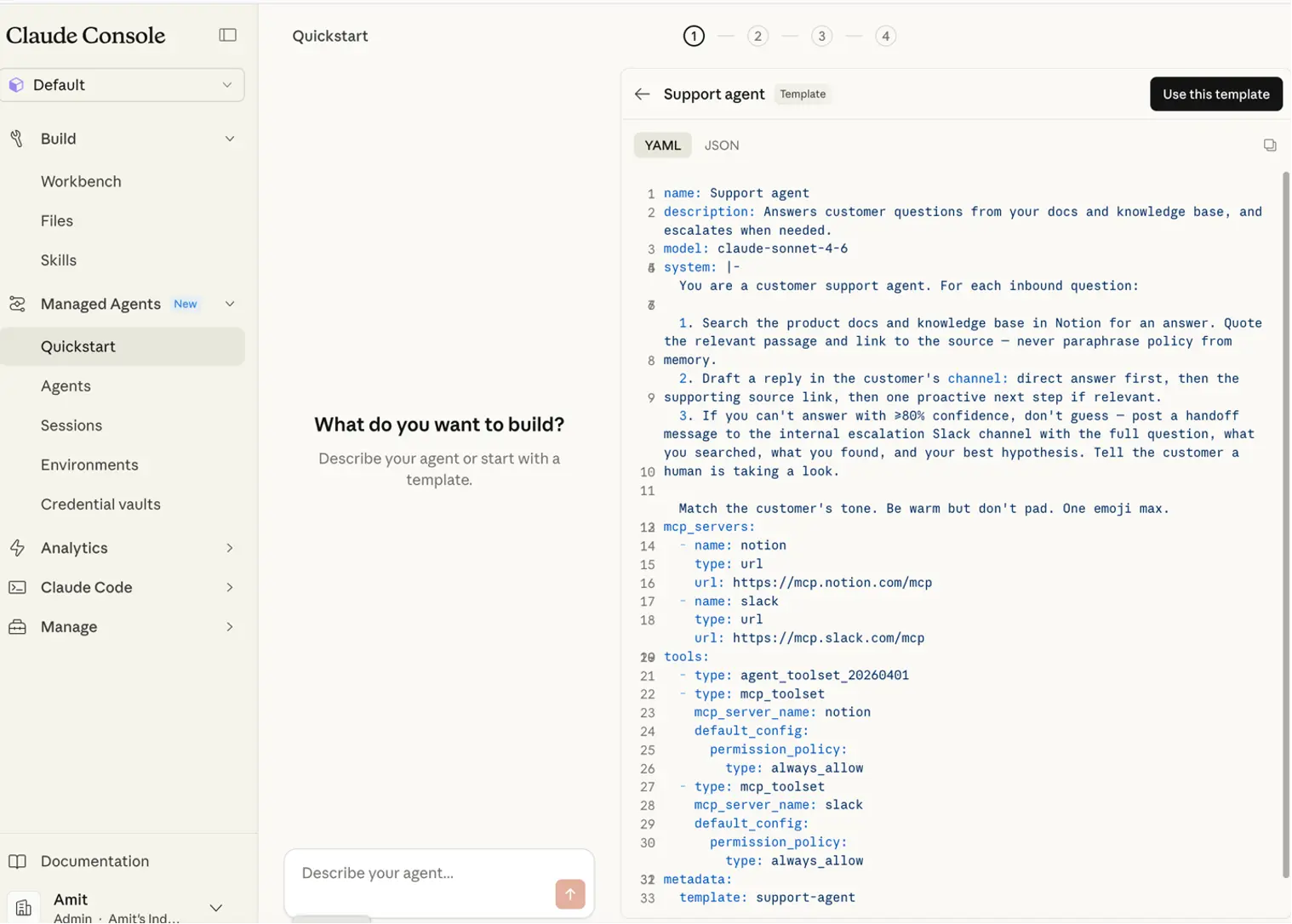
In other words, Claude Managed Agents is not “just a model endpoint with tool calling.” It is more of an Agent runtime factory- give it specification of the agent, and it will run the operational machinery around the agent.
The built-in tools are supported include bash, file operations (read, write, edit, glob, grep), web search and fetch. There is full support for MCP Server connections and Skill.md files that can tailor the Agent behavior. Interestingly, CLAUDE.MD support is missing. The pricing is standard API token rates plus $0.08 per session-hour for active runtime, measured in milliseconds. Idle time does not count. Web search incurs an additional $10 per 1,000 searches.
Security concerns are addressed by two interesting mechanisms, both trying to keep the Harness from ever reading the security tokens. One involves repo tokens cloning the repo and push and pull while other uses a secure credential vault that is accessed thru a proxy for MCP Credentials.
Where it sits in the agent stack
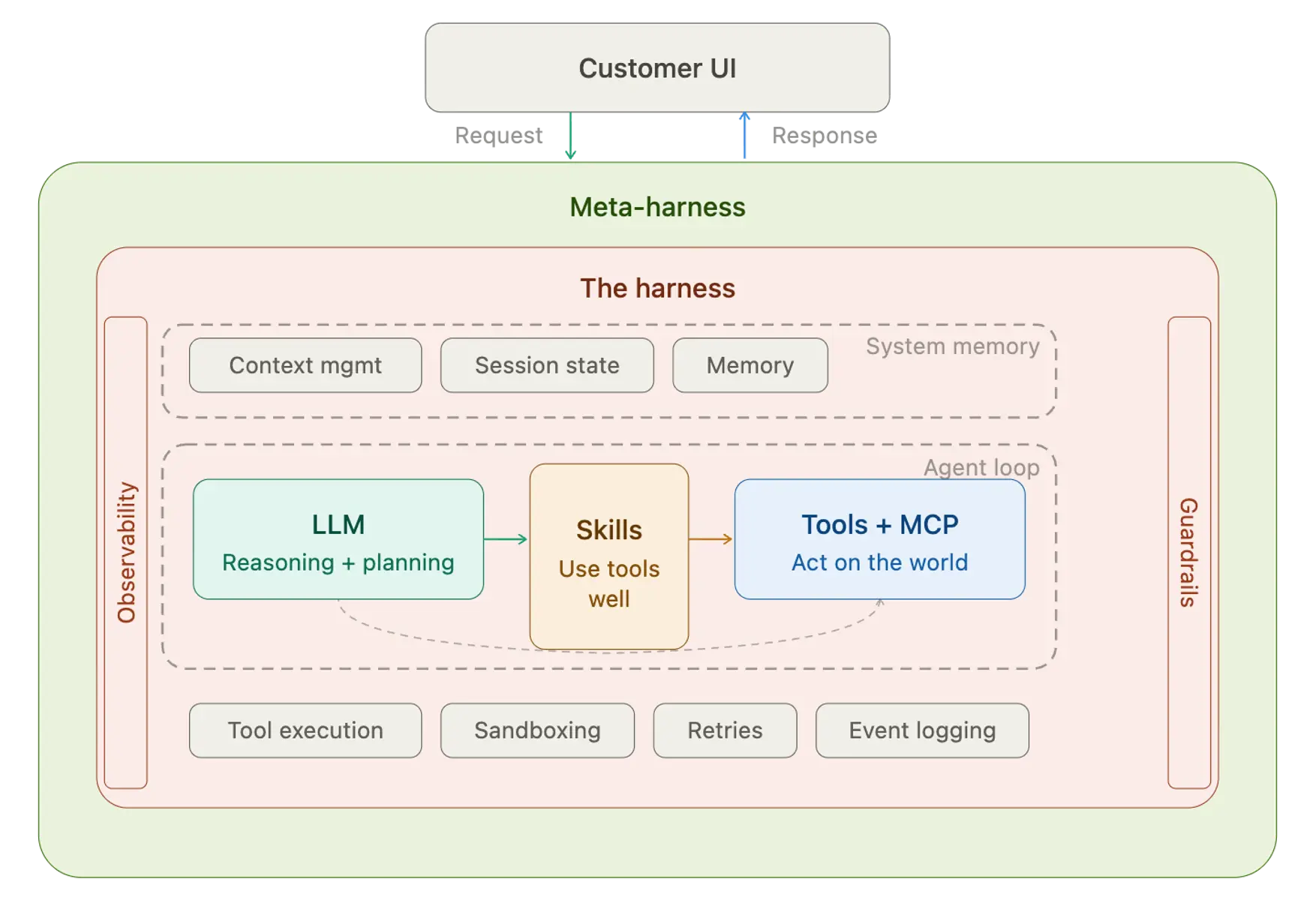
A useful way to think about an agent is this:
the LLM provides reasoning and planning,
tools let it act (including MCP Tools),
skills help it use those tools well,
and the harness manages the loop around all of it.
That harness is the systems engineering part most teams' underestimate. It is the part that handles all the complex bits:
context management
session state
tool execution
sandboxing
security boundaries
memory
retries
event logging
observability
guardrails
If you build agents in production, you quickly realize that the harness often becomes the real differentiator between successful agents and a failed prototype. And that harness gets brittle fast. Anthropic's engineering team explicitly argues that harness assumptions “go stale” as models improve.
Claude Managed Agents is Anthropic's answer to that churn. Instead of every company rewriting its own orchestration layer every few months, Anthropic offers a managed layer that can evolve along with the models.
That is why the right mental model is not simply “managed agents.” It is managed agent infrastructure so not quite a harness but a meta-harness where the harness itself is evolving.
Comparing Claude Managed Agents with similar offerings
Anthropic is far from the only player in this segment. For example, Google positions Gemini Enterprise (a.k.a. Google Agentspace) as an enterprise agentic platform that helps teams “discover, create, share, and run AI agents” in a secure environment grounded in company data. Google also gives admins control over how Gemini Business and Enterprise access Workspace data such as Gmail, Drive, and Calendar.
That means the two platforms overlap, but they are not identical.
Claude Managed Agents is clearly more developer oriented
Claude Managed Agents is best understood as a developer platform for managed autonomous runtimes. It is about giving builders a reusable, versioned agent resource, a managed session runtime, sandboxes, tools, MCP connectivity, and infrastructure abstractions that are meant to survive changes in the underlying harness.
Gemini Enterprise is naturally more “enterprise” focused
Gemini Enterprise, by contrast, is closer to “enterprise AI operating surface” thinking. Google's positioning emphasizes employee workflows, access to business data, agent creation and sharing, and admin controls around Workspace-connected information.
There is clearly no one true way as managed agentic runtimes go – the space is still very new and evolving fast so there is room to experiment with different substrates for agents.
The tradeoffs: Where it makes sense
1. Speed to market
This is the biggest advantage, and in the world of AI Apps, speed is the only muscle.
In the current AI market, new capabilities arrive so quickly that speed is a strategic capability, not a nice-to-have. Managed harnesses let teams focus on business logic rather than on operating the substrate around the agent.
If Anthropic handles the stateful runtime, sandboxing, built-in tooling, streaming, and core orchestration, then the enterprise can spend more time answering the only questions that actually matter:
What should the agent do?
What tools should it have?
What MCP servers should it connect to?
What permissions should it operate under?
What success criteria define good behavior?
That can compress the path from concept to production significantly.
2. Lower harness maintenance
The second advantage is less obvious, but potentially just as important.
When you own your own harness, you also own its rewrites. As model capabilities change, your prompts, context windows, truncation logic, tool-selection rules, and safety controls often need to change too. Anthropic's pitch is that the managed layer absorbs much of that adaptation cost.
If the underlying model gets better, your agent may improve without you having to re-architect your runtime. That is the hope, at least and your mileage my vary depending on the specifics of your agentic use case.
3. Stronger default platform primitives
Claude Managed Agents is an opinionated take on how agent systems should be structured. Their post describes explicit separation between the harness, the session log, and the sandbox, and explains why Anthropic keeps credentials outside the sandbox through resource-bound auth or a vault-backed MCP proxy. Most agentic use cases need a safer and more repeatable default rather than very powerful reasoning – so this may work well for customers.
The trade-offs: Where the costs show-up
1. Vendor lock-in
The key word in Claude Managed Agents is managed.
Anthropic controls the runtime, the abstractions, the operational behavior, and the model layer. Yes, you own your application logic and your front-end experience. But your agent backend becomes strongly coupled to Anthropic's way of structuring the world.
That may be acceptable. In many cases, it is the whole point. But it is still lock-in.
2. Platform reliability becomes your problem too
The second risk is operational dependence.
Anthropic's status history shows a non-trivial number of incidents across Claude.ai, Claude Code, model error rates, authentication, connectors, and workspace creation in early April 2026 alone. That does not mean Anthropic is uniquely unreliable; operating frontier AI systems at scale is hard. But it does mean enterprises should think carefully before placing mission-critical workflows behind a fully managed external harness.
When the provider owns more of the execution path, the blast radius of provider instability grows.
3. Memory and traces can become trapped value
The most valuable part of an agent system is often not the prompt or even the model. It is the accumulated operational intelligence:
Anthropic's Managed Agents docs do expose a memory concept and note that sessions are ephemeral by default unless you explicitly use memory stores (Managed Agents memory docs). That is useful. But the broader concern remains when the provider owns the runtime, your most valuable behavioral footprint can end up structurally dependent on that provider's abstractions and APIs.
For many enterprises, this is not just a technical issue. It is an IP boundary issue.
4. Less freedom to shape the harness itself
Managed infrastructure is attractive precisely because it removes choices. But those removed choices are sometimes where differentiation lives. Teams that want to customize context compaction, tracing semantics, memory representation, security policy composition, or model-routing logic may eventually find the managed path constraining.
That is the trade: speed now versus freedom later.
How Anthropic could make this stronger
If Anthropic wants Claude Managed Agents to become a default enterprise substrate rather than merely a convenient hosted runtime, a few moves would make the platform meaningfully more open.
1. Support BYOM
A bring-your-own-model option would reduce lock-in and let customers use Anthropic's harness abstractions while retaining more control over the intelligence layer.
That would also make the platform more credible as true infrastructure rather than as a packaging layer for Anthropic models alone.
2. Expose more harness customization
Anthropic should keep the easy path opinionated but give advanced teams more ways to customize core behavior: memory semantics, system instruction layering, context handling, tracing, and control-plane logic.
The more serious the enterprise workload, the more these knobs matter.
3. Make memory and traces portable
This is the big one. Customers should be able to export or continuously replicate the agent's memory, traces, and event history into systems they control. If agent learning is part of the company's operating advantage, then portability should not be an afterthought.
The strongest managed platforms will be the ones that let customers move fast without forcing them to surrender their institutional memory.
The harder problem Anthropic is actually solving
Claude Managed Agents is an interesting release. It reflects a maturing view of the agent market: that the real challenge is no longer just model access, but the operational substrate around long-running, tool-using systems. Anthropic is trying to turn that substrate into a product and platform.
For teams that value speed, reduced harness maintenance, and strong defaults, Claude Managed Agents could be a very attractive way to ship. For teams that care deeply about portability, memory ownership, runtime control, and multi-model optionality, the trade-offs are much sharper.




