





Google Calendars ODBC Driver
Read, write, and update Google Calendar through ODBC




The Google Calendar ODBC Driver is a powerful tool that allows you to connect with live data from Google Calendar, directly from any applications that support ODBC connectivity. Access Google Calendar data like you would a database - read, write, and update Google Calendar Calendars, Events, Attendees, etc. through a standard ODBC Driver interface.
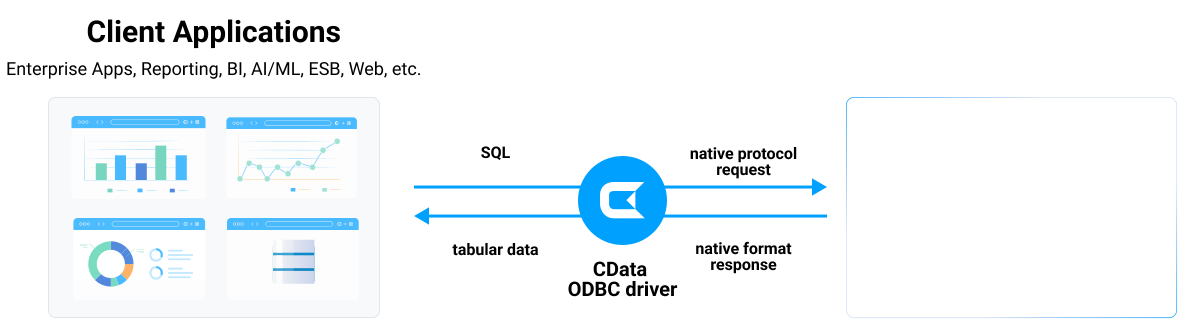
See what you can do with Google Calendar ODBC Driver
Server
Connect to Google Calendar from SQL Server as Linked-Server. You can query Google Calendar from familiar Transact-SQL without need of setting up another application.
Integrate Google Calendar to your system through popular ETL / EAI tools such as Informatica PowerCenter. Standard SQL and Stored Procedures enable fast delivery of your integration projects.
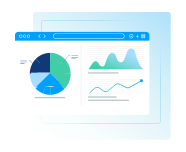
Connect Google Calendar from any ODBC compatible tools:
Desktop
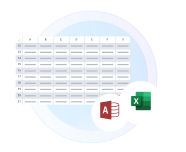
Your familiar tools can connect to Google Calendar using CData ODBC.
- Microsoft Access
- Power Query
- DBeaver
- and more
Google Calendar ODBC Connectivity Features
- Powerful metadata querying enables SQL-like access to non-database sources
- Push down query optimization pushes SQL operations down to the server whenever possible, increasing performance
- Client-side query execution engine, supports SQL-92 operations that are not available server-side
- Connect to live Google Calendar data, for real-time data access with the Google Calendar JDBC Driver
- Full support for data aggregation and complex JOINs in SQL queries
- Secure connectivity through modern cryptography, including TLS 1.2, SHA-256, ECC, etc.
- Seamless integration with leading BI, reporting, and ETL tools and with custom applications via the Google Calendar Connector.
Target Service, API
The driver connects to Google Calendar API. Provides SQL access to calendars, events, and calendar metadata.
Schema, Data Model
Models calendars and events as relational tables. Supports recurring events and complex event properties.
Key Objects
Calendars, Events, Attendees, Reminders, and Calendar Lists. Access to all Google Calendar data for authorized user.
Operations
Full CRUD operations on events. SQL queries with date filtering and text search. Supports batch operations for events.
Authentication
OAuth 2.0 authentication with Google. Requires calendar scope permissions. Supports service account authentication.
Start a 30-day free trial today
Robust ODBC access to Google Calendar
Full-featured and consistent SQL access to any supported data source through ODBC
Connect to Google Calendar—empower every team
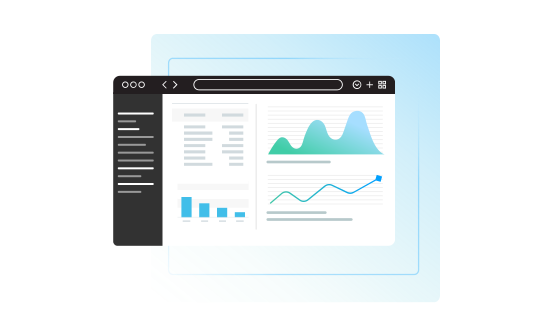
AI-assisted development with CData CLI
Build Google Calendar integrations faster with AI that understands your schema
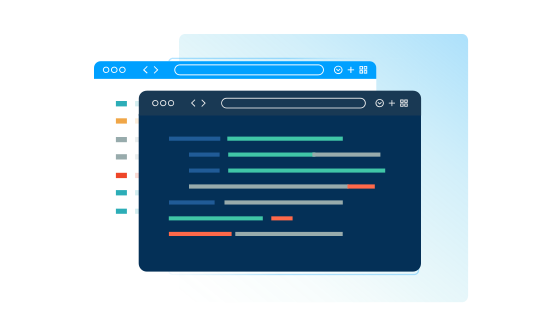
Schema-aware AI
CData CLI gives AI coding tools access to your Google Calendar schema. No more guessing table names or column types—AI sees the same metadata in your ODBC Drivers.
Your AI Knows SQL
How to find table names, column names, and how to generate SQL syntax are things that AI knows well from millions of training data. No need for customization, no hallucinations. Your AI acts like a domain specialist to Google Calendar.
More Accurate, More Token-Efficient
With CData CLI's queryable schema detection and highly efficient queries with filters, aggregation, joins with correct pushdown, your AI will achieve more accuracy with less token usage.
FAQs
Frequently asked Google Calendar ODBC driver questions
Learn more about Google Calendar ODBC drivers for data and analytics integration
- Does Google Calendar support ODBC?
- Is there an ODBC driver for Google Calendar?
- How do I connect to Google Calendar via ODBC?
- Where can I download an ODBC driver for Google Calendar?
- How do I install an ODBC driver for Google Calendar?
- Is the Google Calendar ODBC driver 32-bit or 64-bit?
- Does pyODBC work with Google Calendar?
- Does the ODBC connector support ARM64 devices?
Download the Google Calendar ODBC Driver today!
Get the latest Google Calendar ODBC Drivers for Windows, Linux, and macOS. Install in minutes and connect your Google Calendar data to Power BI, Tableau, and more.