








Connect to Anaplan Data as an External Data Source using PolyBase

PolyBase for SQL Server allows you to query external data by using the same Transact-SQL syntax used to query a database table. When paired with the CData ODBC Driver for Anaplan, you get access to your Anaplan data directly alongside your SQL Server data. This article describes creating an external data source and external tables to grant access to live Anaplan data using T-SQL queries.
NOTE: PolyBase is only available on SQL Server 19 and above.
CData Connect AI provides a pure SQL Server interface for Anaplan, allowing you to query data from Anaplan without replicating the data to a natively supported database. Using optimized data processing out of the box, CData Connect AI pushes all supported SQL operations (filters, JOINs, etc.) directly to Anaplan, leveraging server-side processing to return the requested Anaplan data quickly.
Configure Anaplan Connectivity for PolyBase
Connectivity to Anaplan from PolyBase is made possible through CData Connect AI. To work with Anaplan data from PolyBase, we start by creating and configuring a Anaplan connection.
- Log into Connect AI, click Sources, and then click Add Connection
- Select "Anaplan" from the Add Connection panel
-
Enter the necessary authentication properties to connect to Anaplan.
Authenticating to Anaplan
The driver supports authenticating with Basic, Certificate, or OAuth. In every case, set Region to the region where your Anaplan account data is hosted (e.g., US1, which is the default).
Using Basic Authentication
Set AuthScheme to Basic, then supply your Anaplan User and Password. If your workspace uses single sign-on (SSO), you must be assigned as an Exception User to use Basic authentication.
Using Certificate Authentication
Set AuthScheme to Certificate, then supply the Certificate, CertificateType, and PrivateKey properties (and the matching CertificatePassword / PrivateKeyPassword if either is encrypted). The certificate must be a CA-issued X.509 certificate registered with your Anaplan tenant administrator.
Using OAuth Authentication
Register a custom OAuth application in Anaplan, then set the following properties:
- OAuthClientId: The client Id assigned when you registered your custom OAuth application.
- OAuthClientSecret: The client secret assigned when you registered your custom OAuth application.
- CallbackURL: The redirect URI defined when you registered your application.
- InitiateOAuth: Set to GETANDREFRESH to have the driver manage the OAuth token exchange and refresh automatically.
See the Getting Started chapter of the help documentation for a guide to creating a custom OAuth app and using OAuth.

- Click Save & Test
-
Navigate to the Permissions tab in the Add Anaplan Connection page and update the User-based permissions.



Add a Personal Access Token
When connecting to Connect AI through the REST API, the OData API, or the Virtual SQL Server, a Personal Access Token (PAT) is used to authenticate the connection to Connect AI. It is best practice to create a separate PAT for each service to maintain granularity of access.
- Click on the Gear icon () at the top right of the Connect AI app to open the settings page.
- On the Settings page, go to the Access Tokens section and click Create PAT.
-
Give the PAT a name and click Create.

- The personal access token is only visible at creation, so be sure to copy it and store it securely for future use.
With the connection configured and a PAT generated, you are ready to connect to Anaplan data from Polybase.
Create an External Data Source for Anaplan Data
After configuring the connection, you need to create a credential database for the external data source.
Creating a Credential Database
Execute the following SQL command to create credentials for the external data source connected to Anaplan data.
NOTE: Set IDENTITY to your Connect AI username and set SECRET to your Personal Access Token.
CREATE DATABASE SCOPED CREDENTIAL ConnectCloudCredentials
WITH IDENTITY = 'yourusername', SECRET = 'yourPAT';
Create an External Data Source for Anaplan
Execute a CREATE EXTERNAL DATA SOURCE SQL command to create an external data source for Anaplan with PolyBase:
CREATE EXTERNAL DATA SOURCE ConnectCloudInstance
WITH (
  LOCATION = 'sqlserver://tds.cdata.com:14333',
  PUSHDOWN = ON,
  CREDENTIAL = ConnectCloudCredentials
);
Create External Tables for Anaplan
After creating the external data source, use CREATE EXTERNAL TABLE statements to link to Anaplan data from your SQL Server instance. The table column definitions must match those exposed by CData Connect AI. You can use the Data Explorer in Connect AI to see the table definition.
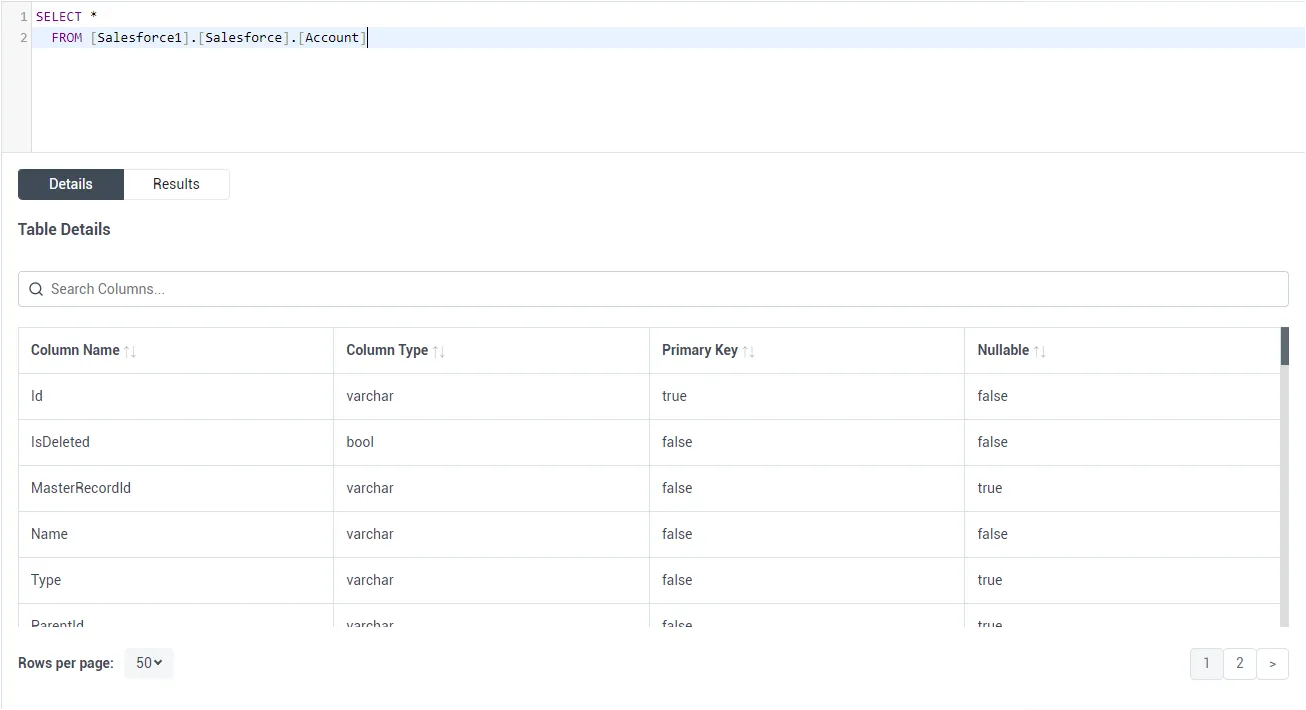
Sample CREATE TABLE Statement
Execute a CREATE EXTERNAL TABLE SQL command to create the external table(s), using the collation and setting the LOCATION to three-part notation for the connection, catalog, and table. The statement to create an external table based on a Anaplan Sales would look similar to the following.
CREATE EXTERNAL TABLE Sales(
  Region COLLATE [nvarchar](255) NULL,
  Product COLLATE [nvarchar](255) NULL,
  ...
) WITH (
  LOCATION='Anaplan1.Anaplan.Sales',
  DATA_SOURCE=ConnectCloudInstance
);
Having created external tables for Anaplan in your SQL Server instance, you are now able to query local and remote data simultaneously. To get live data access to hundreds of SaaS, Big Data, and NoSQL sources directly from your SQL Server database, try CData Connect AI today!