







Getting Started with the CData Connect AI Python SDK for Azure Data Lake Storage

The CData Connect AI Python SDK (cdata-connect-ai) is a DB-API 2.0 (PEP 249) compliant client that lets you fetch and act on live Azure Data Lake Storage data with standard Python database code. Because Connect AI provides the connectivity: you install one package, authenticate with a Personal Access Token, and query Azure Data Lake Storage (and every other source connected in Connect AI) using the same familiar connect() / cursor() / fetchall() pattern you already know from libraries like sqlite3 and psycopg2.
This guide walks through connecting Azure Data Lake Storage in Connect AI, generating a Personal Access Token, installing the SDK, and reading (and, where supported, writing) live Azure Data Lake Storage data.
Prerequisites
- An account in CData Connect AI
- Python 3.8 or higher
- An active Azure Data Lake Storage account with valid credentials
Connect to Azure Data Lake Storage in Connect AI
CData Connect AI uses a straightforward, point-and-click interface to connect to data sources.
- Log into Connect AI, click Sources, and then click Add Connection
- Select "Azure Data Lake Storage" from the Add Connection panel
-
Enter the necessary authentication properties to connect to Azure Data Lake Storage.
Authenticating to a Gen 1 DataLakeStore Account
Gen 1 uses OAuth 2.0 in Entra ID (formerly Azure AD) for authentication.
For this, an Active Directory web application is required. You can create one as follows:
To authenticate against a Gen 1 DataLakeStore account, the following properties are required:
- Schema: Set this to ADLSGen1.
- Account: Set this to the name of the account.
- OAuthClientId: Set this to the application Id of the app you created.
- OAuthClientSecret: Set this to the key generated for the app you created.
- TenantId: Set this to the tenant Id. See the property for more information on how to acquire this.
- Directory: Set this to the path which will be used to store the replicated file. If not specified, the root directory will be used.
Authenticating to a Gen 2 DataLakeStore Account
To authenticate against a Gen 2 DataLakeStore account, the following properties are required:
- Schema: Set this to ADLSGen2.
- Account: Set this to the name of the account.
- FileSystem: Set this to the file system which will be used for this account.
- AccessKey: Set this to the access key which will be used to authenticate the calls to the API. See the property for more information on how to acquire this.
- Directory: Set this to the path which will be used to store the replicated file. If not specified, the root directory will be used.

- Click Save & Test
- Navigate to the Permissions tab and update the user-based permissions.



Generate a Personal Access Token (PAT)
The Python SDK authenticates to Connect AI with your account email and a Personal Access Token (PAT). It is best practice to create a separate PAT for each application to maintain granularity of access.
- Click the Gear icon () at the top right of the Connect AI app to open the Settings page.
- On the Settings page, go to the Access Tokens section and click Create PAT.
- Give the PAT a name and click Create.
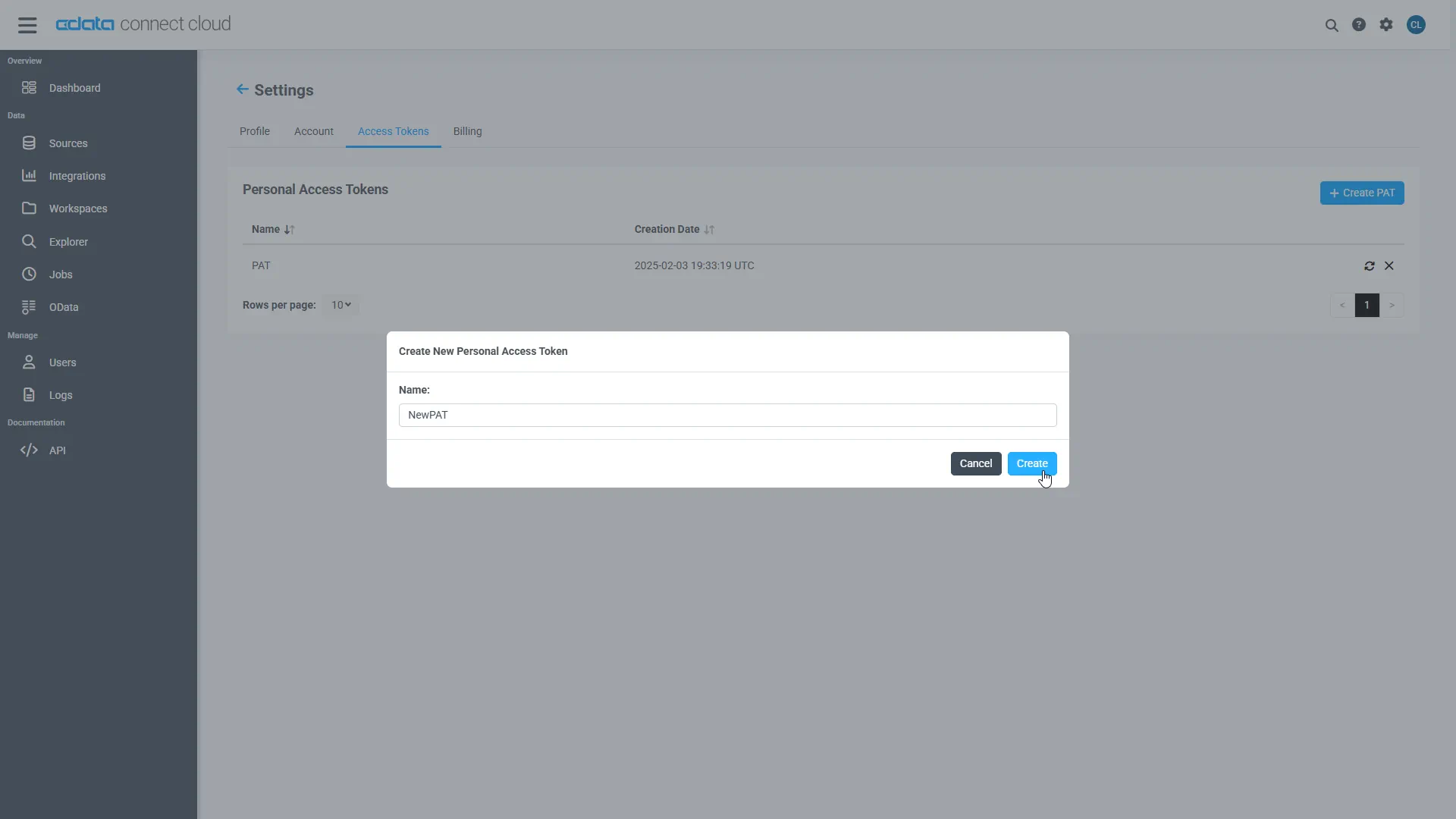
- The PAT is only visible at creation, so copy it and store it securely.
Install the SDK
Install the SDK from PyPI with pip:
pip install cdata-connect-ai
Connect and Run Your First Query
Connect with your account email and PAT, then query sys_tables to discover every table available across your connected sources. Identifiers in Connect AI are three-part: <Connection>.<Schema>.<Table>, where the connection name defaults to the source name (for example, ADLS1).
import cdata_connect_ai

conn = cdata_connect_ai.connect(
    username="[email protected]",
    password="<your_pat>",
)
cur = conn.cursor()

# Discover what's available across your connected sources
cur.execute("SELECT CatalogName, SchemaName, TableName FROM sys_tables LIMIT 25")

for row in cur.fetchall():
    print(row)
Pick any table from the results and query it directly:
cur.execute(
    "SELECT FullPath, Permission "
    "FROM [ADLS1].[ADLS].[Resources] "
    "LIMIT 10"
)

for row in cur.fetchall():
    print(row)
Azure Data Lake Storage is a read-only source in Connect AI, so the SDK supports queries but not INSERT, UPDATE, or DELETE. Close the connection when you are finished:
conn.close()
That is the entire workflow: one package, a PAT, and standard DB-API calls. Because the SDK returns a normal DB-API connection, it drops straight into the rest of the Python data ecosystem. From here you can load Azure Data Lake Storage data into pandas, build ETL pipelines with petl, or power a Dash web app, all using this same connection.
More Information and Free Trial
Now you can query live Azure Data Lake Storage data from Python through the CData Connect AI Python SDK. For more information on connecting to Azure Data Lake Storage (and hundreds of other data sources), visit the Connect AI page. Sign up for a free trial and start working with live Azure Data Lake Storage data in Python.