





Connect AI documentation · Full API reference & configuration details
Developer Guide - Build AI-Powered Data Assistants with OpenAI Python SDK
Build intelligent data assistants that can query your live data sources using natural language. This guide walks you through creating a Python application that combines OpenAI's GPT models with CData Connect AI to enable conversational access to your data.
NOTE: While this guide uses Google Sheets as the data source, the same principles apply to any of the hundreds of data sources CData Connect AI supports.
By the end of this guide, you'll have a working Python application that can:
- Connect to any of hundreds of data sources through CData Connect AI
- Discover available databases, schemas, and tables automatically
- Execute SQL queries using natural language
- Maintain multi-turn conversations with context
- Stream responses in real-time
Architecture overview
The application uses the Model Context Protocol (MCP) to bridge OpenAI's GPT models with your data sources:
┌─────────────────┐     ┌──────────────────┐     ┌─────────────────┐
│                 │     │                  │     │                 │
│  Your Python    │---->│  CData Connect   │---->│  Data Sources   │
│  Application    │     │  AI MCP Server   │     │ (100s of types) │
│                 │<----│                  │<----│                 │
└─────────────────┘     └──────────────────┘     └─────────────────┘
        |                        |
        |    Tool Discovery      |
        |    & Execution         |
        v                        |
┌─────────────────┐              |
│                 │              |
│  OpenAI API     │--------------┘
│  (GPT-4, etc.)  │   Natural Language
│                 │   to SQL Translation
└─────────────────┘
How it works:
- Your Python application connects to CData Connect AI's MCP server
- The MCP server exposes tools for data discovery and querying
- OpenAI's GPT models use these tools to translate natural language into SQL
- Queries are executed against your live data sources
- Results are returned and interpreted by the AI
Prerequisites
This guide requires the following:
- Python 3.9+ installed on your system
- An OpenAI API key (requires a paid account)
- A Connect AI account, either Developer Edition (free, MCP-only) or a 14-day Connect AI trial
- A Google account for the sample Google Sheets data
Getting started
Overview
Here's a quick overview of the steps:
- Set up sample data in Google Sheets
- Configure CData Connect AI and create a Personal Access Token
- Set up the Python project and install dependencies
- Build and run the chat application
Step 1: Set up sample data in Google Sheets
We'll use a sample Google Sheet containing customer data to demonstrate the capabilities. This dataset includes accounts, sales opportunities, support tickets, and usage metrics.
- Navigate to the sample customer health spreadsheet
- Click File > Make a copy to save it to your Google Drive
- Give it a memorable name (e.g., "demo_organization") - you'll need this later
The spreadsheet contains four sheets:
- account: Company information (name, industry, revenue, employees)
- opportunity: Sales pipeline data (stage, amount, probability)
- tickets: Support tickets (priority, status, description)
- usage: Product usage metrics (job runs, records processed)
Step 2: Configure CData Connect AI
2.1 Sign up or log in
- Sign up at cloud.cdata.com/developer for free Developer Edition, or request a Connect AI trial if you need non-MCP access, caching, workspaces, or higher call volume. Existing users: log in here
- Complete the registration process if creating a new account
2.2 Add a Google Sheets connection
-
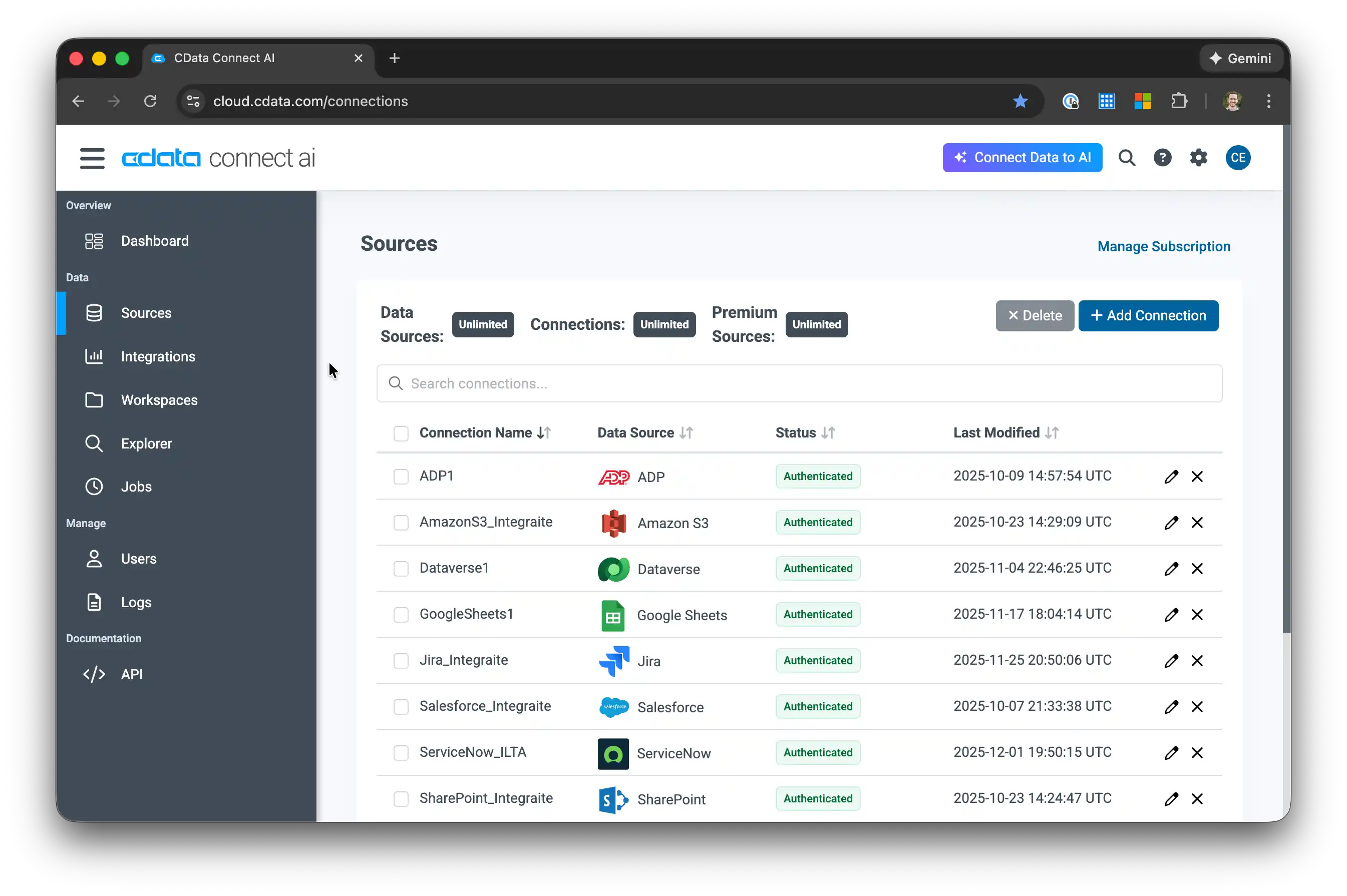
Once logged in, click Sources in the left navigation menu and click Add Connection
-
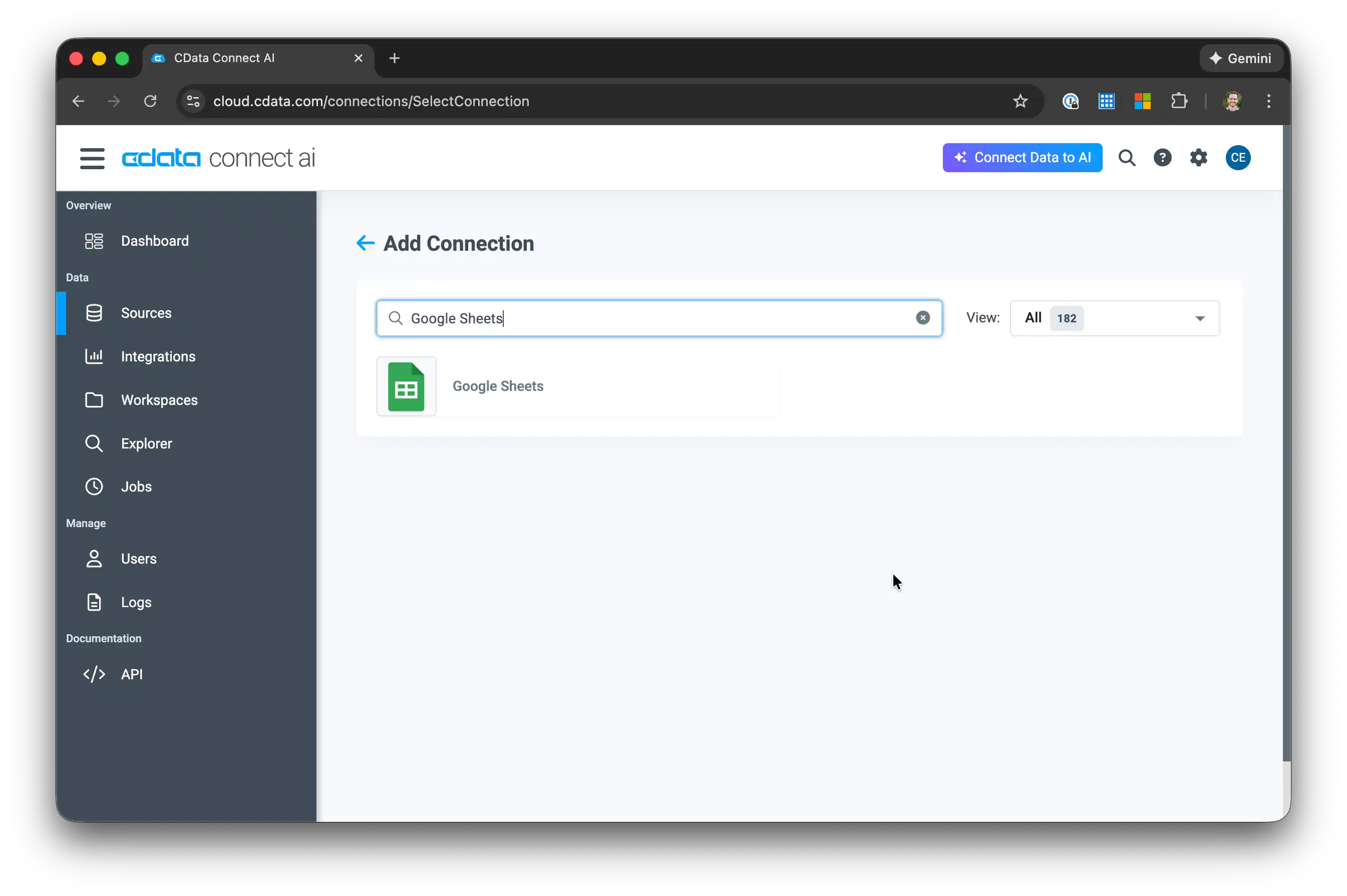
Select Google Sheets from the Add Connection panel
-
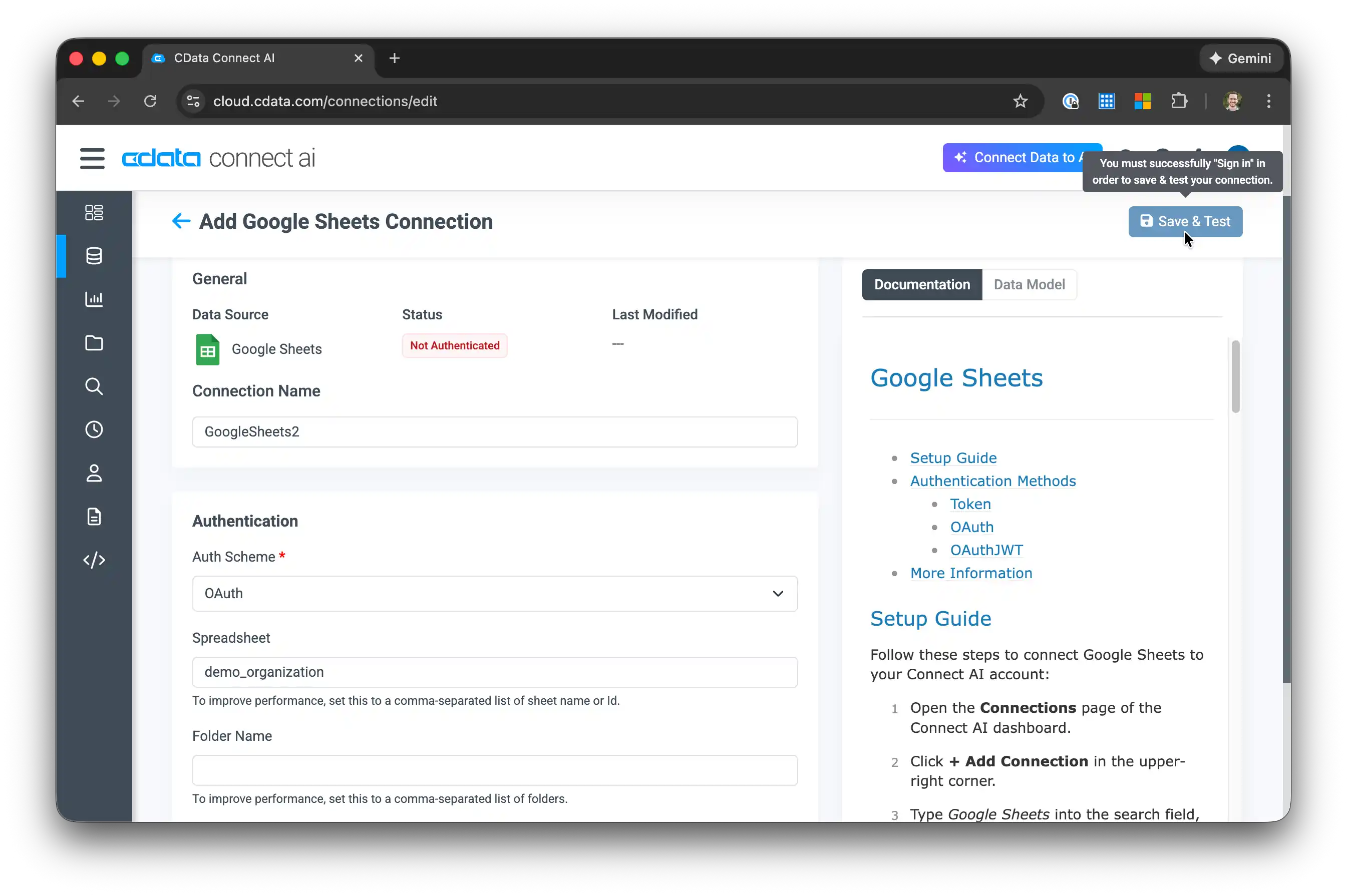
Configure the connection:
- Set the Spreadsheet property to the name of your copied sheet (e.g., "demo_organization")
- Click Sign in to authenticate with Google OAuth
-
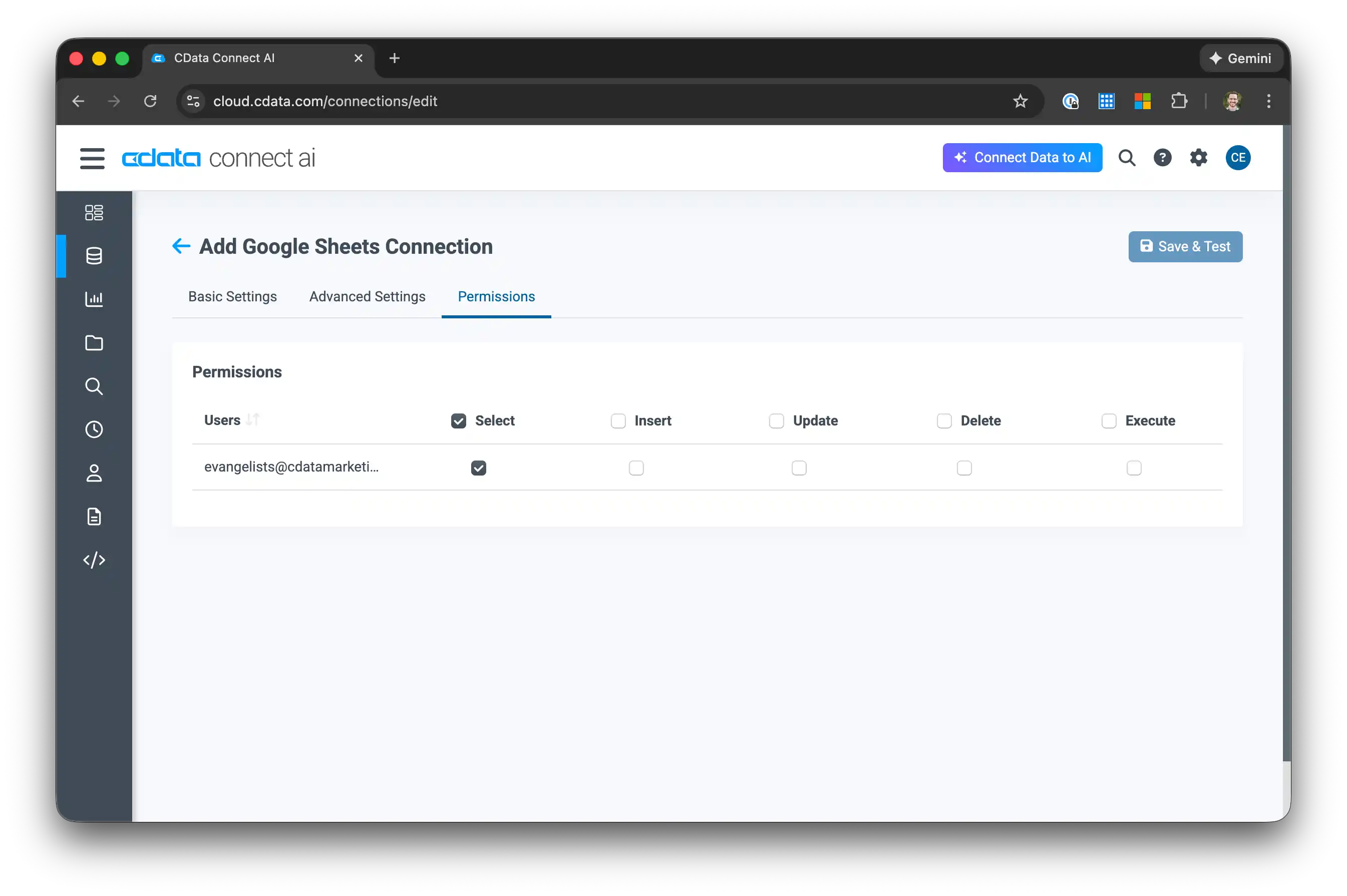
After authentication, navigate to the Permissions tab and verify your user has access
2.3 Create a Personal Access Token
Your Python application will use a Personal Access Token (PAT) to authenticate with Connect AI.
- Click the Gear icon in the top right to open Settings
- Go to the Access Tokens section
- Click Create PAT
-
Give the token a name (e.g., "OpenAI Python App") and click Create
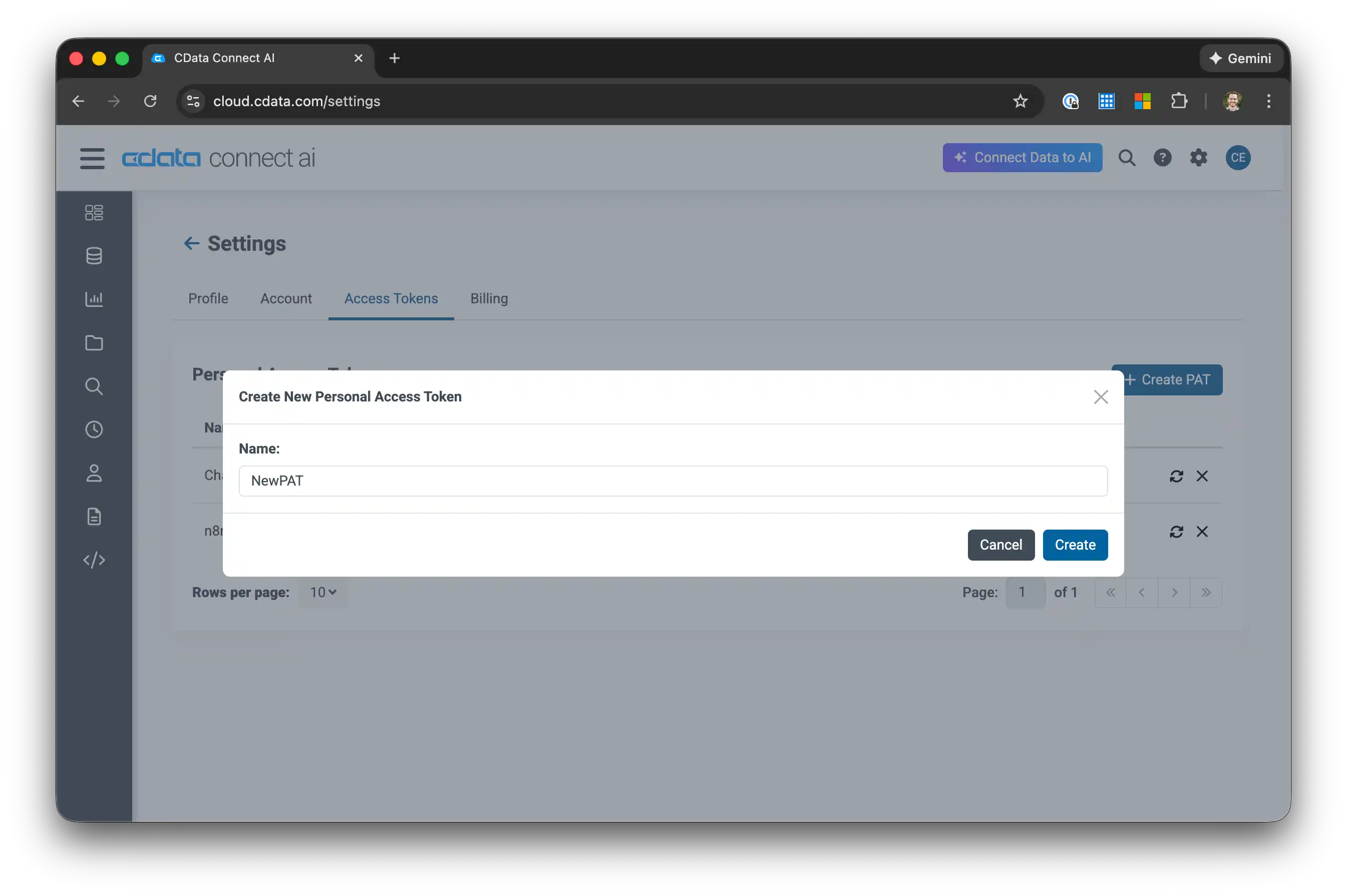
- Important: Copy the token immediately - it's only shown once!
Step 3: Set up the Python project
3.1 Clone from GitHub (recommended)
Clone the complete project with all examples:
git clone https://github.com/CDataSoftware/connectai-openai-agent.git
cd connectai-openai-agent
pip install -r requirements.txt
3.2 Alternative: Create from scratch
Create a new project directory and install dependencies:
mkdir connectai-openai-agent
cd connectai-openai-agent
pip install openai httpx python-dotenv
3.3 Configure environment variables
Create a .env file in your project root:
# OpenAI Configuration
OPENAI_API_KEY=sk-your-openai-api-key-here
OPENAI_MODEL=gpt-4o

# CData Connect AI Configuration
[email protected]
CDATA_PAT=your-personal-access-token-here
MCP_SERVER_URL=https://mcp.cloud.cdata.com/mcp
Replace the placeholder values with your actual credentials.
Step 4: Understanding the code architecture
The project consists of three main components:
4.1 Config class
Handles configuration and credential management:
from dataclasses import dataclass
import os
import base64

@dataclass
class Config:
    """Configuration for the Connect AI OpenAI Agent."""
    openai_api_key: str
    cdata_email: str
    cdata_pat: str
    openai_model: str = "gpt-4o"
    mcp_server_url: str = "https://mcp.cloud.cdata.com/mcp"

    @classmethod
    def from_env(cls) -> "Config":
        """Create configuration from environment variables."""
        return cls(
            openai_api_key=os.getenv("OPENAI_API_KEY"),
            cdata_email=os.getenv("CDATA_EMAIL"),
            cdata_pat=os.getenv("CDATA_PAT"),
            openai_model=os.getenv("OPENAI_MODEL", "gpt-4o"),
            mcp_server_url=os.getenv("MCP_SERVER_URL", "https://mcp.cloud.cdata.com/mcp"),
        )

    def get_auth_header(self) -> str:
        """Generate Base64 authentication header."""
        credentials = f"{self.cdata_email}:{self.cdata_pat}"
        return base64.b64encode(credentials.encode()).decode()
4.2 Mcpclient class
Handles HTTP communication with the CData Connect AI MCP server:
import json
import sys
import httpx

class MCPClient:
    """HTTP client for CData Connect AI MCP server."""

    def __init__(self, config: Config):
        self.config = config
        self._client = httpx.Client(
            headers={
                "Content-Type": "application/json",
                "Accept": "application/json, text/event-stream",
                "Authorization": f"Basic {config.get_auth_header()}",
                "User-Agent": f"CDataConnectAI-OpenAIAgent (Python/{sys.version_info.major}.{sys.version_info.minor})",
            },
            timeout=60.0,
        )

    def _parse_sse_response(self, response_text: str) -> dict:
        """Parse Server-Sent Events response."""
        for line in response_text.split("
"):
            if line.startswith("data: "):
                return json.loads(line[6:])
        raise ValueError("No data found in SSE response")

    def list_tools(self) -> list:
        """Discover available tools from the MCP server."""
        response = self._client.post(
            self.config.mcp_server_url,
            json={"jsonrpc": "2.0", "method": "tools/list", "params": {}, "id": 1},
        )
        result = self._parse_sse_response(response.text)
        return result.get("result", {}).get("tools", [])

    def call_tool(self, tool_name: str, arguments: dict) -> dict:
        """Execute a tool on the MCP server."""
        response = self._client.post(
            self.config.mcp_server_url,
            json={
                "jsonrpc": "2.0",
                "method": "tools/call",
                "params": {"name": tool_name, "arguments": arguments},
                "id": 2,
            },
        )
        result = self._parse_sse_response(response.text)
        return result.get("result", \{})
4.3 Mcpagent class
The AI agent that combines OpenAI with MCP tools:
from openai import OpenAI

class MCPAgent:
    """AI Agent using OpenAI with CData Connect AI MCP tools."""

    def __init__(self, config: Config):
        self.config = config
        self.mcp_client = MCPClient(config)
        self.openai_client = OpenAI(api_key=config.openai_api_key)
        self.conversation_history = []
        self._tools_cache = []

    def _get_openai_tools(self) -> list:
        """Convert MCP tools to OpenAI function format."""
        if not self._tools_cache:
            mcp_tools = self.mcp_client.list_tools()
            for tool in mcp_tools:
                self._tools_cache.append({
                    "type": "function",
                    "function": {
                        "name": tool.get("name"),
                        "description": tool.get("description", ""),
                        "parameters": tool.get("inputSchema", {}),
                    },
                })
        return self._tools_cache

    def chat(self, message: str) -> str:
        """Send a message and get a response."""
        self.conversation_history.append({"role": "user", "content": message})

        messages = [
            {"role": "system", "content": "You are a data assistant..."},
            *self.conversation_history,
        ]

        tools = self._get_openai_tools()

        # Process until we get a final response
        for _ in range(10):
            response = self.openai_client.chat.completions.create(
                model=self.config.openai_model,
                messages=messages,
                tools=tools if tools else None,
            )

            assistant_message = response.choices[0].message

            if assistant_message.tool_calls:
                messages.append(assistant_message.model_dump())
                for tool_call in assistant_message.tool_calls:
                    result = self.mcp_client.call_tool(
                        tool_call.function.name,
                        json.loads(tool_call.function.arguments)
                    )
                    messages.append({
                        "role": "tool",
                        "tool_call_id": tool_call.id,
                        "content": json.dumps(result),
                    })
            else:
                content = assistant_message.content or ""
                self.conversation_history.append({"role": "assistant", "content": content})
                return content

        return "Max iterations reached."
Step 5: Build the chat application
Create an interactive chat application:
#!/usr/bin/env python3
"""Interactive chat application for querying data with AI."""

from dotenv import load_dotenv
from src.connectai_openai import Config, MCPAgent

load_dotenv()

def main():
    print("=" * 60)
    print("CData Connect AI - OpenAI Chat Assistant")
    print("=" * 60)

    # Initialize
    config = Config.from_env()
    agent = MCPAgent(config)
    tools = agent._get_openai_tools()
    print(f"
Connected! {len(tools)} tools available.")

    print("
Chat with your data! Type 'quit' to exit.
")

    while True:
        user_input = input("You: ").strip()

        if user_input.lower() in ("quit", "exit"):
            print("Goodbye!")
            break

        response = agent.chat(user_input)
        print(f"
Assistant: {response}
")

if __name__ == "__main__":
    main()
Step 6: Run your application
With everything configured, run your chat application:
python examples/basic_chat.py
You should see output like:
============================================================
CData Connect AI - OpenAI Chat Assistant
============================================================

Connected! 8 tools available.

Chat with your data! Type 'quit' to exit.

You: What data sources do I have?

Assistant: You have the following data sources connected:

1. **demo_organization** (Google Sheets)
   - Tables: account, opportunity, tickets, usage

Would you like me to explore any of these in more detail?
Step 7: Example queries
Here are some example prompts to try with your data assistant:
Data discovery
- "What data sources do I have connected?"
- "Show me all the tables in demo_organization"
- "What columns are in the account table?"
Basic queries
- "Query the top 5 accounts by annual_revenue"
- "How many support tickets are there by priority?"
- "Show me all open opportunities"
Analysis
- "Which accounts have the most critical support tickets?"
- "Summarize the health of Aurora Healthcare Systems"
- "Find accounts with high revenue but low product usage"
Step 8: Available MCP tools
Your AI agent has access to these CData Connect AI tools:
| Tool | Description |
|---|---|
| getCatalogs | List available data source connections |
| getSchemas | Get schemas for a specific catalog |
| getTables | Get tables in a schema |
| getColumns | Get column metadata for a table |
| queryData | Execute SQL queries |
| getProcedures | List stored procedures |
| getProcedureParameters | Get procedure parameter details |
| executeProcedure | Execute stored procedures |
Step 9: SQL query format
When the AI generates SQL queries, it uses fully qualified table names:
SELECT [column1], [column2]
FROM [CatalogName].[SchemaName].[TableName]
WHERE [column1] = 'value'
ORDER BY [column2]
LIMIT 100
For example, to query the account table from your Google Sheets:
SELECT [name], [annual_revenue], [industry]
FROM [demo_organization].[GoogleSheets].[account]
ORDER BY [annual_revenue] DESC
LIMIT 10
Troubleshooting
Authentication errors
- Verify your CData email and PAT are correct in .env
- Ensure the PAT has not expired
- Check that your Connect AI account is active
No tools available
- Confirm you have at least one data source connected in Connect AI
- Check that your user has permissions to access the connection
Query errors
- Use fully qualified table names: [Catalog].[Schema].[Table]
- Verify column names exist using the getColumns tool
- Check SQL syntax (Connect AI uses SQL-92 standard)
What's next?
Now that you have a working AI data assistant, you can:
- Connect more data sources: Add Salesforce, Snowflake, or any of hundreds of supported sources to expand your data access.
- Customize the agent: Modify the system instructions for your specific use case and domain.
- Build production applications: Integrate the agent into web apps, Slack bots, or other interfaces.
- Add streaming: Use chat_stream() for real-time response streaming.
- Explore the examples: Check out the additional examples in the GitHub repository for data analysis workflows, multi-source queries, and more.
Resources
- GitHub Repository - Complete source code and examples
- CData Connect AI Documentation
- CData Prompt Library - Example prompts for various use cases
- OpenAI API Documentation
- Model Context Protocol
Get started with CData Connect AI
Ready to build AI-powered data applications? CData Connect AI provides live data access to hundreds of SaaS, Big Data, and NoSQL sources directly from your AI applications.
Two ways to start: Developer Edition (free, MCP-only, limited sources/users/calls) or a 14-day Connect AI trial. Start building intelligent data assistants today!
Full API reference, authentication guides, and configuration details.