







Connecting GenSpark with Okta Data via CData Connect AI MCP Server

GenSpark is built for developers and enterprise teams who want to create intelligent, conversational AI experiences powered by real-time data. It's flexible tooling and agentic capabilities make it easy to integrate LLMs, automate complex workflows, and build interactive applications that adapt to user intent. However, when these AI interactions require data beyond local context or predefined APIs, many implementations fall back on custom middleware, manual integrations, or scheduled ETL pipelines to sync information into local stores. This introduces unnecessary complexity, increases maintenance overhead, slows response times, and limits the real-time intelligence your GenSpark agents can provide.
CData Connect AI eliminates these barriers by delivering live, secure connectivity to more than 300 enterprise applications, databases, ERPs, and analytics platforms. Through CData Connect AI remote Model Context Protocol (MCP) Server, GenSpark agents can query, read, and act on real-time enterprise data without replication or custom integration code. The result is grounded, accurate responses, faster reasoning, and automated, cross-system decision-making all with stronger governance and fewer moving parts.
This guide outlines the steps required to configure CData Connect AI MCP connectivity, register the MCP Server in GenSpark, and enable your GenSpark agents to work seamlessly with live enterprise data in real time.
Prerequisites
Before starting, ensure you have:
- A CData Connect AI account
- Access to GenSpark
- Access to Okta
Credentials checklist
Ensure you have these credentials ready for the connection:
- USERNAME: Your CData email login
- PAT: Connect AI, go to Settings and click on Access Tokens (copy once)
- MCP_BASE_URL: https://mcp.cloud.cdata.com/mcp
Step 1: Configure Okta connectivity for GenSpark
Connectivity to Okta from GenSpark is made possible through CData Connect AI Remote MCP. To interact with Okta data from GenSpark, we start by creating and configuring a Okta connection in CData Connect AI.
- Log into Connect AI, click Sources, and then click Add Connection
- Select "Okta" from the Add Connection panel
-
Enter the necessary authentication properties to connect to Okta.
To connect to Okta, set the Domain connection string property to your Okta domain.
You will use OAuth to authenticate with Okta, so you need to create a custom OAuth application.
Creating a Custom OAuth Application
From your Okta account:
- Sign in to your Okta developer edition organization with your administrator account.
- In the Admin Console, go to Applications > Applications.
- Click Create App Integration.
- For the Sign-in method, select OIDC - OpenID Connect.
- For Application type, choose Web Application.
- Enter a name for your custom application.
- Set the Grant Type to Authorization Code. If you want the token to be automatically refreshed, also check Refresh Token.
- Set the callback URL:
- For desktop applications and headless machines, use http://localhost:33333 or another port number of your choice. The URI you set here becomes the CallbackURL property.
- For web applications, set the callback URL to a trusted redirect URL. This URL is the web location the user returns to with the token that verifies that your application has been granted access.
- In the Assignments section, either select Limit access to selected groups and add a group, or skip group assignment for now.
- Save the OAuth application.
- The application's Client Id and Client Secret are displayed on the application's General tab. Record these for future use. You will use the Client Id to set the OAuthClientId and the Client Secret to set the OAuthClientSecret.
- Check the Assignments tab to confirm that all users who must access the application are assigned to the application.
- On the Okta API Scopes tab, select the scopes you wish to grant to the OAuth application. These scopes determine the data that the app has permission to read, so a scope for a particular view must be granted for the driver to have permission to query that view. To confirm the scopes required for each view, see the view-specific pages in Data Model < Views in the Help documentation.

- Click Save & Test
-
Navigate to the Permissions tab in the Add Okta Connection page and update the User-based permissions.



Add a Personal Access Token
A Personal Access Token (PAT) is used to authenticate the connection to Connect AI from GenSpark. It is best practice to create a separate PAT for each service to maintain granularity of access.
- Click on the Gear icon () at the top right of the Connect AI app to open the settings page.
- On the Settings page, go to the Access Tokens section and click Create PAT.
-
Give the PAT a name and click Create.

- The personal access token is only visible at creation, so be sure to copy it and store it securely for future use.
With the connection configured and a PAT generated, we are ready to connect to Okta data from GenSpark.
Step 2: Configure MCP Server in GenSpark
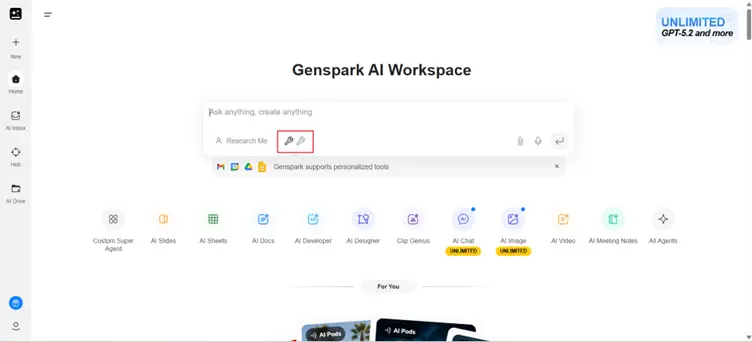
- Log in to GenSpark
- Below the chat interface, click the Tools icon
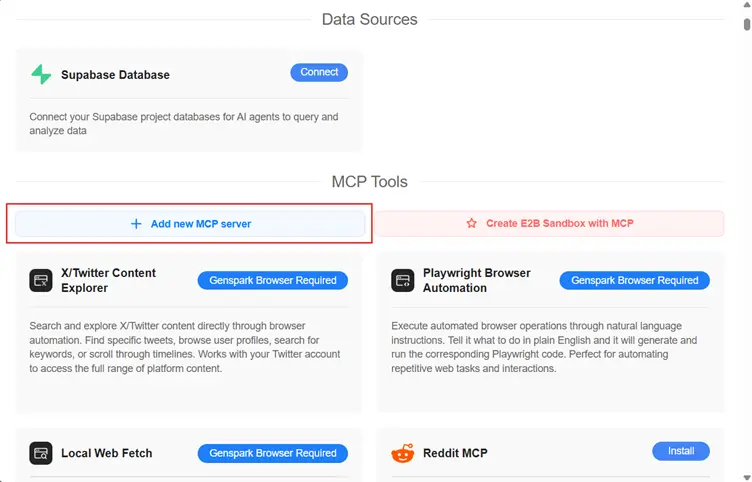
- Select Add new MCP server
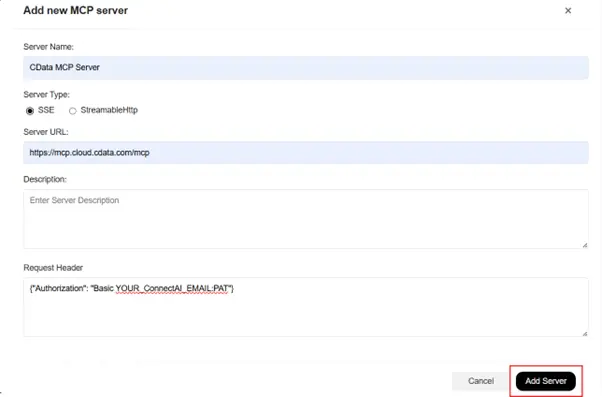
Fill in the server configuration:
NOTE: Use Basic authentication, where you combine your Connect AI email address (e.g. [email protected]) with the PAT you generated earlier (e.g. AbC123...xYz890) with a colon (:) in the Authorization header.
Field Value Name CData MCP Server (or any name you prefer) Server Type SteamableHttp Server URL https://mcp.cloud.cdata.com/mcp Request Header {"Authorization": "Basic [email protected]:AbC123...xYz890"} - Click Add Server
Once added, GenSpark will automatically load all MCP tools exposed through your Connect AI workspace.
Step 3: Query data in GenSpark
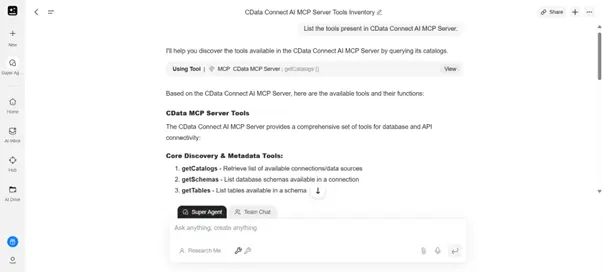
In GenSpark chat interface enter any sample prompt:
List the tools present in CData Connect AI MCP Server.
Build real-time, data-aware agents with GenSpark and CData
GenSpark and CData Connect AI together enable intelligent, AI-driven workflows where agents can securely access live enterprise data and operate with real-time awareness without ETL pipelines, data sync jobs, or custom integration logic. This streamlined approach delivers stronger governance, lower operational overhead, and faster, more grounded responses from your AI tools.
Start your free trial today to see how CData can empower GenSpark with live, secure access to hundreds of external systems.