Through CData Connect AI, companies can now leverage AI while remaining HIPAA compliant. To bring AI use cases to production, health and life sciences organizations need data integration infrastructure that can operate inside a HIPAA compliance framework. Connect AI now does exactly that. Under a signed business associate agreement (BAA), healthcare covered entities and their business associates can use Connect AI to access and leverage electronic protected health information (ePHI) across their systems, with the encryption, access controls, audit logging, and breach notification procedures HIPAA requires.
What HIPAA compliance means at the platform level
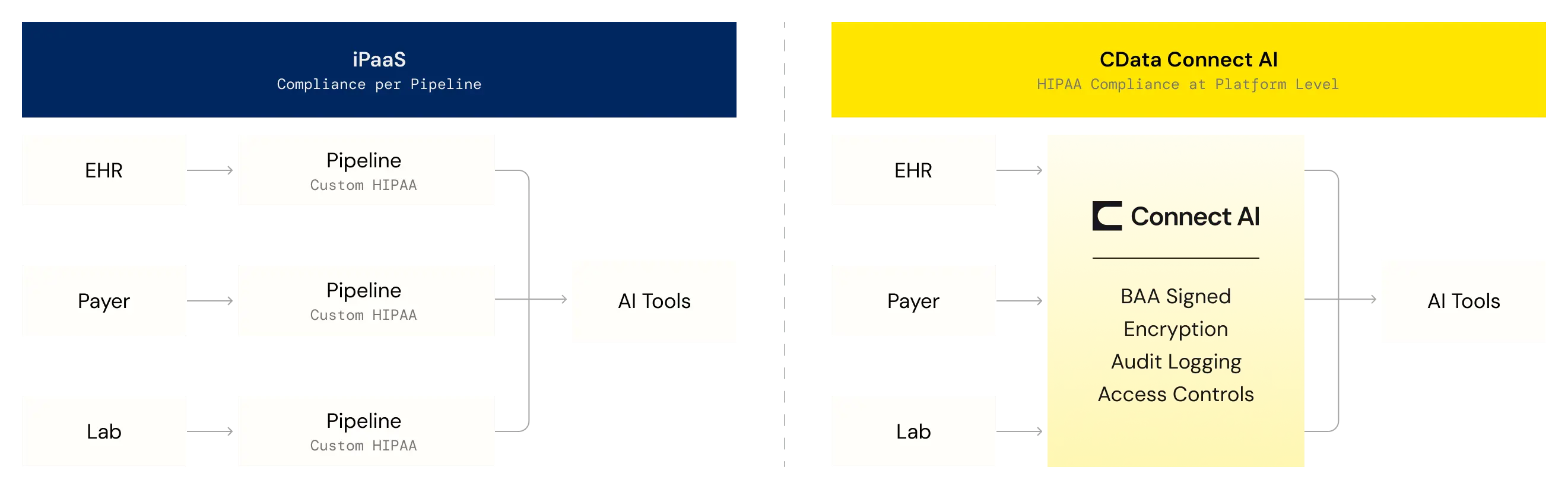
Many AI integration tools treat compliance as an organizational responsibility that your team must layer on top of the platform. Most source-native MCP Servers, integration platform as a service (iPaaS) solutions, and AI orchestrators like Zapier push HIPAA compliance down to the implementation team, not the platform. HIPAA's Security Rule requires controls at the data layer: row- and column-level access controls, audit logging of ePHI access, encryption in transit and at rest, and documented data flows. Most iPaaS platforms enforce access at the pipeline level, not the data level, and orchestrators have the same blind spot from a different angle—they're scheduling and dependency tools with no concept of ePHI, so every pipeline node that touches patient data carries a compliance obligation the orchestrator itself cannot see or enforce.
In healthcare, where data lives across electronic health records (EHRs), payer systems, laboratory platforms, and clinical data warehouses—each with different APIs, schemas, and access patterns—this status quo model means every new integration is a net-new compliance engineering effort. AI teams end up waiting on infrastructure teams. Infrastructure teams wait on compliance review.
Connect AI is designed to solve this bottleneck, enforcing the technical safeguards HIPAA mandates at the platform level: encryption in transit and at rest, role-based access controls (RBAC), use case-specific workspaces, automatic logoff, and audit logging of ePHI access. CData signs the BAA, designates a HIPAA Security and Privacy Officer, and documents the ePHI data flows your compliance team needs to reference in audits. You're not building a compliance case from scratch around your integration layer.
Deploy production-ready AI applications and agents with Connect AI
AI ambitions across healthcare providers, health tech companies, pharmaceutical manufacturers, and consumer health companies have dramatically outpaced data readiness. The constraint is no longer AI model capability — it is governed, secure, HIPAA-compliant connectivity to the fragmented data systems your organizations depend on.
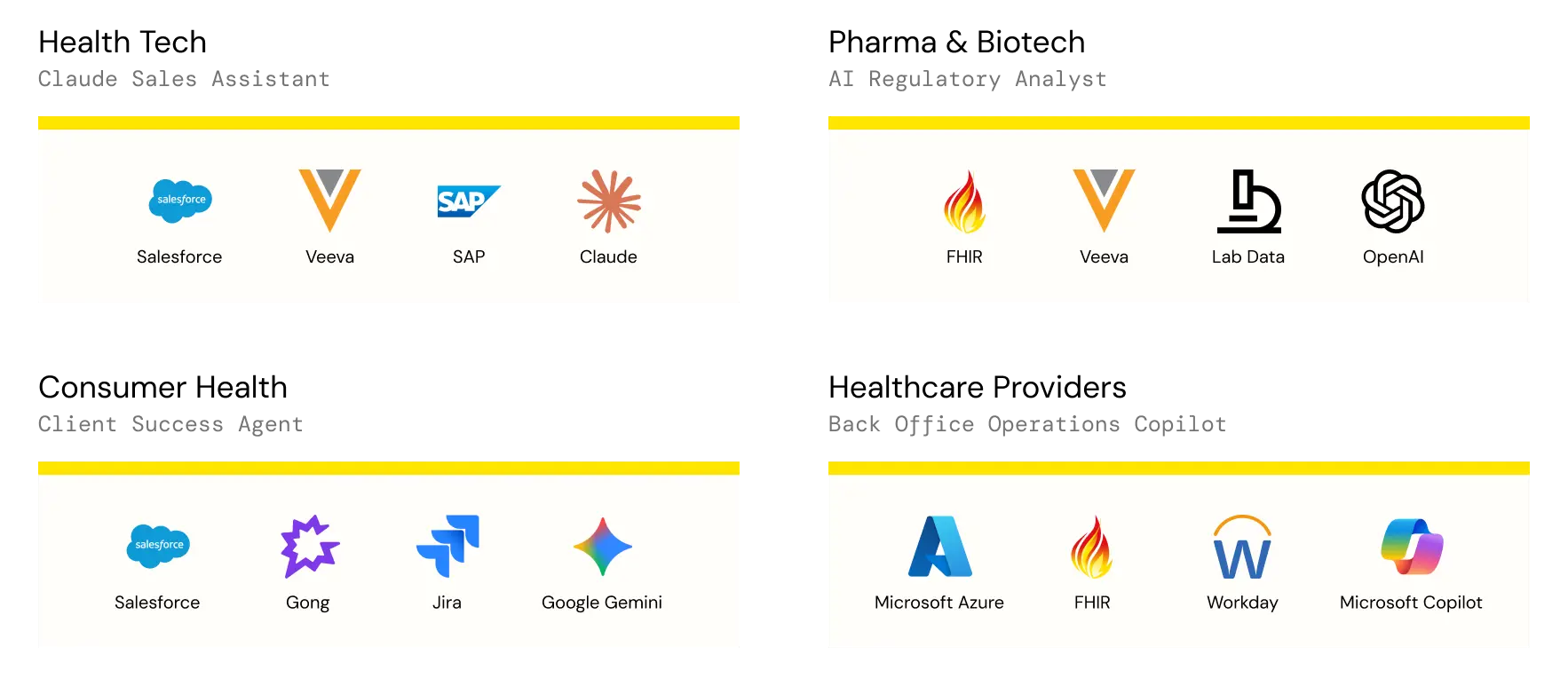
For health tech firms: Tame MCP sprawl and drive sales and operational efficiency by connecting your AI tools, assistants, and workflows to a controlled data layer spanning your real-time internal data sources like Salesforce, Veeva, SAP, and more. Additionally, product teams can now focus on shipping product features, not connectors, and they replace months of per-customer EHR integration engineering with a single, maintained connector library that scales across every health system you serve.
For pharmaceuticals and biotech: Back-office teams can gain real time insights and automate actions across their internal applications and on-premises systems. And clinical and manufacturing teams can prepare submission-ready data pipelines across R&D, clinical, and commercial systems — with the audit trail, lineage, and GxP documentation that regulators expect.
For consumer health companies: Drive more efficient, more personalized client success to drive net revenue retention (NRR) in an increasingly competitive consumer health market. By connecting data across your CRM, support tickets, call recordings, and client profiles to your chosen AI tool, client success teams are now proactively prepared for any challenge or upgrade opportunity that comes their way.
For healthcare providers: With CData, healthcare providers can now securely leverage HIPAA-protected data through Microsoft CoPilot, OpenAI, Claude, or your chosen AI tool — deploying ERP and EHR-connected AI assistants, automated workflows throughout provider networks, and real-time analytics across multiple EHR, CRM, and ERP systems from a single, centralized control plane.
Accelerating operations while controlling risk for your teams
The security requirements and data complexity of health and life science companies is unparalleled across industries. Capturing AI-driven value from years or even decades of data spread across numerous systems, while following strict HIPAA guidelines and internal security practices, has proven challenging enough to keep most AI initiatives from leaving pilot stages. Connect AI’s approach to these challenges delivers peace of mind for IT and security teams, operational efficiencies for delivery teams, and a rapid path to production for development teams.
For IT and security teams: Connect AI satisfies the business associate requirements of HIPAA—including encryption, access controls, PII detection, automatic logoff, and breach notification procedures. Your compliance documentation comes from the platform: the BAA, the ePHI flow map, and the audit logs. You can reference them in audits without relying on custom-built infrastructure your engineering team has to maintain and validate.
For operations and delivery teams: Healthcare data doesn't have to stay siloed to stay compliant. Clinical, operations, and analytics teams can access and move ePHI across systems—EHRs, payer platforms, data warehouses, enterprise applications—without waiting for bespoke integration builds to clear compliance review. Your IT and compliance teams get the documentation and controls; your teams get the data access.
For developers: Connect AI's hundreds of pre-built connectors now operate inside a HIPAA-compliant architecture. You can build ePHI connections into the AI tools your organization already uses without writing and validating custom compliance logic for each one. The BAA, the audit logging, and the access controls are handled at the platform level.
Learn more about PII detection and token masking in the Connect AI June Release
Start building in your HIPAA-regulated workflows
If you're operating in healthcare or handling ePHI on behalf of covered entities, Connect AI now supports that workload. The technical safeguards are already in place—execute a BAA with CData and configure Connect AI as your integration layer.
Learn more about CData Connect AI