







Use Dash to Build Web Apps on Sugar CRM Data via CData Connect AI

The rich ecosystem of Python modules lets you get to work quickly and integrate your systems more effectively. With the CData Connect AI Python SDK, the pandas module, and the Dash framework, you can build Sugar CRM-connected web applications for Sugar CRM data. This article shows how to connect to Connect AI and use pandas and Dash to build a simple web app for visualizing Sugar CRM data.
The Connect AI Python SDK (cdata-connect-ai) is a DB-API 2.0 (PEP 249) compliant client, so pandas can read query results directly from the SDK connection object. There is no driver to install per source: connect with a Personal Access Token and build your app.
Connect to Sugar CRM in Connect AI
CData Connect AI uses a straightforward, point-and-click interface to connect to data sources.
- Log into Connect AI, click Sources, and then click Add Connection
- Select "Sugar CRM" from the Add Connection panel
-
Enter the necessary authentication properties to connect to Sugar CRM.
The User and Password properties, under the Authentication section, must be set to valid SugarCRM user credentials. This will use the default OAuth token created to allow client logins. OAuthClientId and OAuthClientSecret are required if you do not wish to use the default OAuth token.
You can generate a new OAuth consumer key and consumer secret in Admin -> OAuth Keys. Set the OAuthClientId to the OAuth consumer key. Set the OAuthClientSecret to the consumer secret.
Additionally, specify the URL to the SugarCRM account.
Note that retrieving SugarCRM metadata can be expensive. It is advised that you store the metadata locally as described in the "Caching Metadata" chapter of the help documentation.

- Click Save & Test
- Navigate to the Permissions tab and update the user-based permissions.



Generate a Personal Access Token (PAT)
The Python SDK authenticates to Connect AI with your account email and a Personal Access Token (PAT). It is best practice to create a separate PAT for each application to maintain granularity of access.
- Click the Gear icon () at the top right of the Connect AI app to open the Settings page.
- On the Settings page, go to the Access Tokens section and click Create PAT.
- Give the PAT a name and click Create.

- The PAT is only visible at creation, so copy it and store it securely.
Install Required Modules
Install the SDK (with the pandas extra), Dash, and Plotly using the pip utility:
pip install "cdata-connect-ai[full]"
pip install dash
pip install plotly
Build a Web App on Sugar CRM Data in Python
Once the required modules are installed, you are ready to build the web app. Code snippets follow, but the full source code is available at the end of the article.
First, import the modules, then connect to Connect AI with your account email and PAT and read Sugar CRM data into a DataFrame. Identifiers are three-part: <Connection>.<Schema>.<Table>, where the connection name defaults to the source name (for example, SugarCRM1).
import dash
from dash import dcc, html
import pandas as pd
import plotly.graph_objs as go
import cdata_connect_ai

conn = cdata_connect_ai.connect(
    username="[email protected]",
    password="<your_pat>",
)

df = pd.read_sql(
    "SELECT Name, AnnualRevenue "
    "FROM [SugarCRM1].[SugarCRM].[Accounts] "
    "WHERE Name = 'Bob'",
    conn,
)

conn.close()
Configure the App and Layout
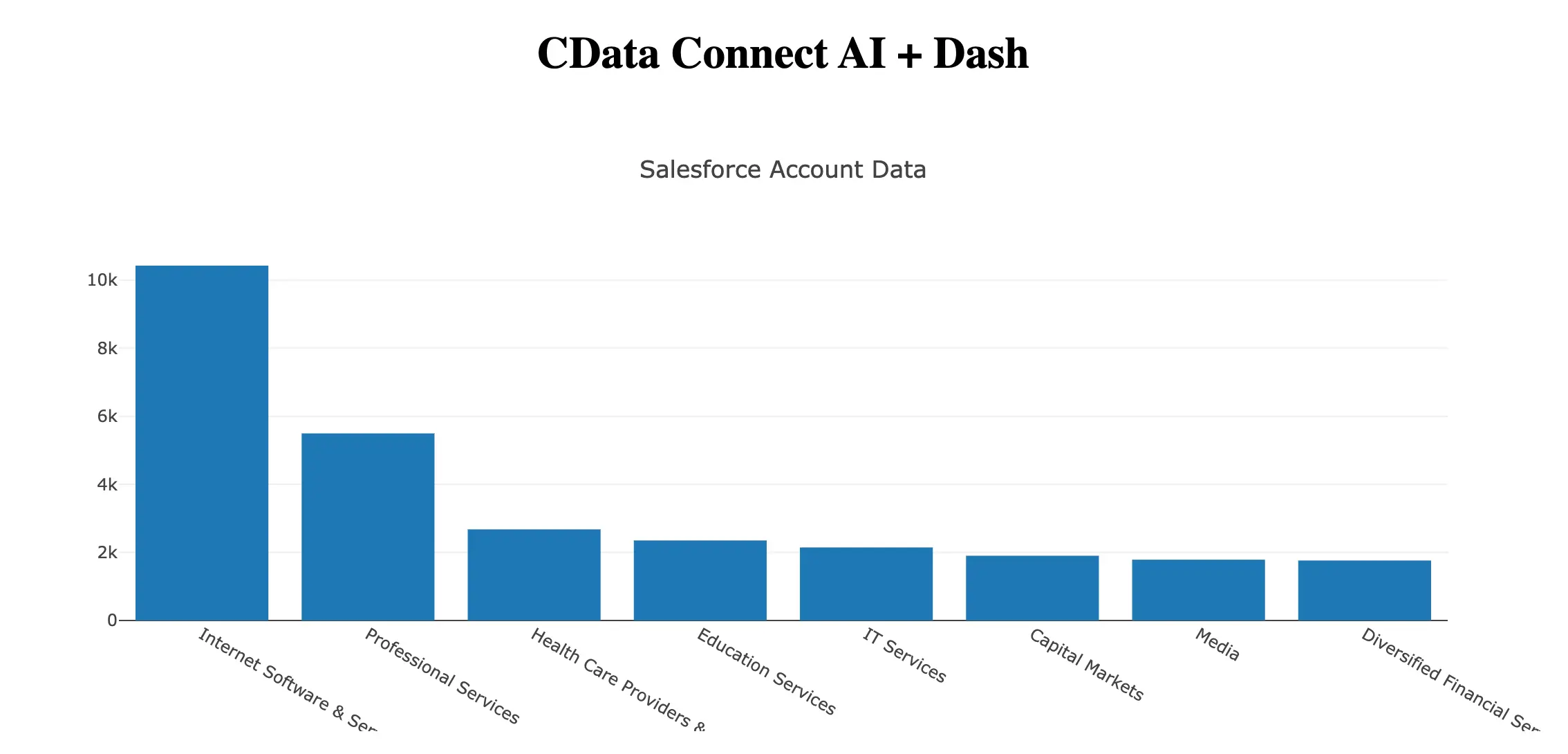
With the query results stored in a DataFrame, build a bar graph from the Sugar CRM data and configure the app layout.
app = dash.Dash(__name__)
app.title = 'CData Connect AI + Dash'

trace = go.Bar(x=df['Name'], y=df['AnnualRevenue'], name='Name')

app.layout = html.Div(
    children=[
        html.H1("CData Connect AI + Dash", style={'textAlign': 'center'}),
        dcc.Graph(
            id='example-graph',
            figure={
                'data': [trace],
                'layout': go.Layout(title='Sugar CRM Accounts Data', barmode='stack'),
            },
        ),
    ],
    className="container",
)
Set the App to Run
With the connection, app, and layout configured, you are ready to run the app.
if __name__ == '__main__':
    app.run(debug=True)
Now, use Python to run the web app and a browser to view the Sugar CRM data.
python sugarcrm-dash.py
More Information and Free Trial
Now you can build interactive Dash web apps on live Sugar CRM data using the CData Connect AI Python SDK. For more information on connecting to Sugar CRM (and hundreds of other data sources), visit the Connect AI page. Sign up for a free trial and start building web apps on live Sugar CRM data in Python.
Full Source Code
import dash
from dash import dcc, html
import pandas as pd
import plotly.graph_objs as go
import cdata_connect_ai

conn = cdata_connect_ai.connect(
    username="[email protected]",
    password="<your_pat>",
)

df = pd.read_sql(
    "SELECT Name, AnnualRevenue "
    "FROM [SugarCRM1].[SugarCRM].[Accounts] "
    "WHERE Name = 'Bob'",
    conn,
)

conn.close()

app = dash.Dash(__name__)
app.title = 'CData Connect AI + Dash'

trace = go.Bar(x=df['Name'], y=df['AnnualRevenue'], name='Name')

app.layout = html.Div(
    children=[
        html.H1("CData Connect AI + Dash", style={'textAlign': 'center'}),
        dcc.Graph(
            id='example-graph',
            figure={
                'data': [trace],
                'layout': go.Layout(title='Sugar CRM Accounts Data', barmode='stack'),
            },
        ),
    ],
    className="container",
)

if __name__ == '__main__':
    app.run(debug=True)