Manufacturing organizations depend on accurate operational data to keep production running and supply chains intact. That data rarely lives in one place. Inventory levels reside in ERP systems. Supplier lead times sit inside procurement platforms. Logistics status flows through transportation management tools. Production throughput belongs to MES systems.
When operations teams need a unified picture, they pull from each system manually, normalize the numbers, and assemble a report that is already stale by the time it reaches a decision-maker. This blog covers how to change that using CData Connect AI and an orchestration workflow like n8n to build an agent-driven command centre that monitors operational risk continuously and delivers interpreted intelligence automatically.
The monitoring challenge in manufacturing environments
Operational monitoring in manufacturing is harder than it appears. Data exists across systems that were not designed to be queried together. Each source has its own schema, authentication requirements, and field naming conventions. Inventory on hand might be qty_available in one system and stock_level in another.
Traditional monitoring approaches compound this problem. Hardcoded SQL queries assume schemas stay stable. Fixed threshold rules evaluate one variable in isolation, so compound risk conditions go undetected until they cascade. Every time a source system is upgraded, the integrations feeding the monitoring layer need to be rebuilt. The result is a monitoring infrastructure that is expensive to maintain, slow to adapt, and structurally incapable of reasoning across multiple data sources simultaneously.
How CData Connect AI addresses the data layer problem
Agent-driven monitoring requires a data layer that handles authentication, schema discovery, and query execution across multiple enterprise systems through a single interface. CData Connect AI provides this through an MCP (Model Context Protocol) server that exposes connected sources as a standardized, SQL-queryable endpoint.
Building this without Connect AI means a custom connector per system, separate authentication logic per source, a normalization layer to reconcile schemas, and a governance layer on top. That is a significant engineering investment before any monitoring logic is written, and it has to be repeated whenever a source system changes. Connect AI compresses all of it into one governed connection. Three capabilities make it particularly suited to manufacturing workflows:
Unified data access: A single MCP endpoint gives agents consistent SQL-based access to ERP, MES, CRM, procurement, logistics, and finance systems with no system-specific connector logic inside the workflow.
Runtime schema discovery: Agents inspect table and column definitions at the start of each run. When a field is renamed or a table is restructured, the agent adapts automatically.
Centralized access governance: Role-based access control, policy-based data exposure, and full query auditability are enforced at the Connect AI layer and applied consistently across every workflow.
What gets built: a manufacturing intelligence command centre
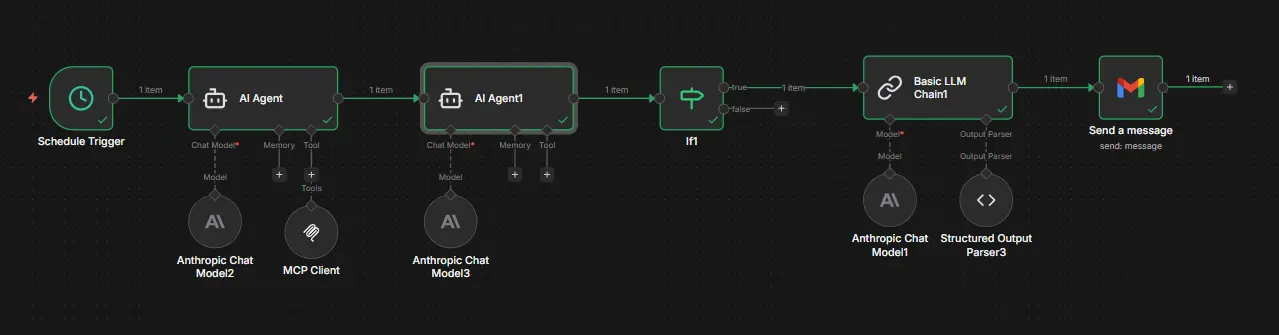
The result is an n8n workflow that runs on a schedule, retrieves live operational data through Connect AI's MCP endpoint, evaluates risk conditions using LLM reasoning, and delivers an executive-level alert to the relevant stakeholders before situations require escalation. n8n handles orchestration. Connect AI handles data access and schema discovery. Claude models handle reasoning, with a lighter model for retrieval and a more capable model for risk analysis and report generation.
How Connect AI accelerated building the workflow
Connect AI made this workflow straightforward to build by handling everything at the data layer before the first line of agent logic was written. A single MCP endpoint provided immediate SQL-based access to every connected enterprise system, with authentication, schema translation, and normalization managed at the platform level. Runtime schema discovery meant the workflow adapted automatically when field names or table structures changed, removing the need for manual connector maintenance after every source system upgrade. Role-based access control and query auditability came built in, so governance was enforced from day one without requiring a separate layer on top.
The practical effect was that almost all of the engineering effort went directly into building the agent reasoning, risk classification, and alert logic rather than the infrastructure underneath it. Connecting a new source system meant adding a configuration in Connect AI, not writing and testing a new connector. Governance and access controls applied automatically to every workflow built on top of the same endpoint, so adding a new use case did not require revisiting the security model. What could have taken weeks of connector development and integration work was reduced to a single configuration step, making the workflow faster to build and significantly easier to maintain as the connected systems evolve over time.
How the workflow operates
Scheduled data retrieval
The workflow fires automatically at a configured cadence, hourly or daily. A Discovery Agent connects to Connect AI's MCP endpoint, inspects the tables available across connected systems, identifies those relevant to inventory, suppliers, and demand, and retrieves aggregated metrics through SQL queries constructed at runtime. The agent begins each run with no prior assumptions about the current schema. It discovers what is available, determines what is relevant, and retrieves it dynamically.
Without Connect AI, this requires building separate connectors for each source system, mapping field names across platforms, and maintaining all of it as systems change. With Connect AI, the agent makes a single connection and receives normalized data from every connected source in return. Authentication, translation, and normalization happen inside Connect AI, not inside the workflow.
Risk evaluation across multiple variables
The structured metrics pass to a Risk Analysis Agent that evaluates conditions across all categories simultaneously. A threshold rule can flag low inventory. It cannot determine whether that decline, combined with extended supplier lead times and rising production demand, represents an imminent stock-out requiring immediate procurement action. The Risk Analysis Agent evaluates these compound conditions, classifies each as CRITICAL, WARNING, or NORMAL, and documents the quantitative evidence behind each classification.
This level of reasoning is only reliable when the input data is clean and consistently structured. Because Connect AI normalizes data before it reaches this stage, the agent works with comparable metrics regardless of which systems they originated in.
Severity filtering and alert delivery
The severity gate passes only WARNING and CRITICAL conditions forward. Runs returning NORMAL do not generate an alert, which is what keeps every notification meaningful and prevents the alert fatigue that causes monitoring systems to be ignored over time.
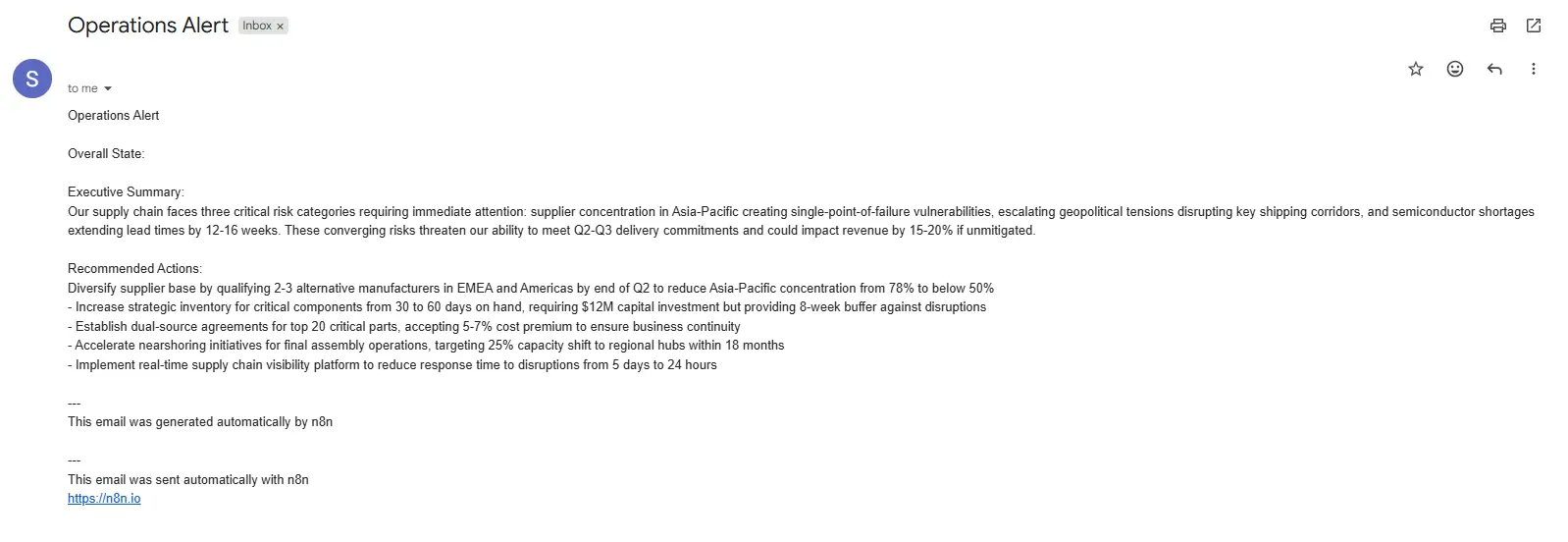
The Reporting Agent produces an executive summary covering identified risks, business impact, and recommended actions, written for procurement managers and supply chain leads rather than data analysts. The summary is delivered to configured channels - email, Slack, or Microsoft Teams — while there is still time to act.
Connect AI credentials have no exposure to the LLM, and LLM credentials have no access to Connect AI. Each component authenticates within its own boundary.
The complete workflow is available on CData's GitHub. Sample data is included so the pipeline can be run end-to-end and outputs reviewed before any production system is connected.
What Connect AI replaces in this architecture
Concern | Without Connect AI | With Connect AI |
System connectivity | Custom connector built and maintained per source system | Single MCP endpoint covers all connected sources |
Schema changes | Manual query updates each time a field or table structure changes | Agent re-discovers the current schema at runtime on every run |
Cross-system reasoning | Threshold rules evaluate one system at a time; compound conditions go undetected | LLM evaluates correlated conditions across normalized data from all sources |
Authentication | Credentials configured and rotated independently per source | Single token managed at the Connect AI level |
Connector maintenance | Integrations require updates whenever a source API or schema changes | CData maintains connectors; the workflow continues unaffected |
Operational outcomes
Stock-out risk is identified while procurement can still act. Declining inventory combined with extending supplier lead times is surfaced as a compound risk before the production schedule is affected.
Overstock exposure is detected before carrying costs accumulate. Inventory accumulating beyond current demand signals is identified early, giving teams time to adjust procurement volumes or redirect stock.
Supplier deterioration is visible as a pattern, not a crisis. Incremental declines in delivery reliability appear as trends in the monitoring output rather than only becoming apparent after a disruption.
Stakeholders receive intelligence that is already interpreted. Executive alerts include the severity classification, the quantitative basis for it, and the recommended response. Recipients act immediately rather than spending time deciphering raw data.
Applying this pattern to other operational domains
The manufacturing command centre is one application of this architecture. The same pattern — a governed data layer, agent-based reasoning, and severity-filtered alerting — applies wherever monitoring depends on data distributed across more than one system:
Procurement: Track supplier reliability and alert when on-time delivery rates fall outside acceptable parameters.
Plant operations: Monitor throughput across production lines and catch efficiency drops before they affect delivery commitments.
Logistics: Assess fulfilment cycle times by warehouse and flag slowdowns before they breach customer SLA windows.
Financial operations: Track actual spend against budget by business unit and surface variances while they are still addressable.
Each connector configured in Connect AI is available to every workflow built on top of it. A team that configures ERP and procurement connectivity for supply chain monitoring inherits that connectivity automatically when building any subsequent workflow.
The GitHub repository is publicly available for teams that want to review the structure and adapt it to their own requirements.
Modernize manufacturing intelligence with CData Connect AI
CData Connect AI provides AI agents with secure, governed access to ERP, production, supplier, and logistics systems through a single unified interface. Organizations looking to move past manually assembled operational reporting can use this architecture to build a monitoring pipeline that reasons across live data, identifies compound risks early, and delivers interpreted intelligence automatically. Start a 14-day free trial today!





