Something surprising is happening in Claude Code. It was built for engineers, but more and more of the people opening it aren't writing software at all. They're operations managers, analysts, finance leads, and founders.
It's easy to see why. Claude Code can read and write your files, so it works with the spreadsheets, contracts, and documents you already have. And it follows skills: written playbooks that walk it through a process the way you'd want it done, step by step, every time. You can hand it a complex, multi-step task and trust it to follow the method, not just improvise an answer.
If you've felt that pull, here's what changes next—and it's significant.
Is your Claude a junior, or a seasoned businessperson?
Think about the difference between a fresh graduate and an experienced businessperson.
Ask a brand-new hire a hard question and you get an instant, confident answer, and then you quietly go check it, because they answered from general knowledge, not from your situation. One question, one answer, move on. That's the junior move. It's also exactly how most people use an AI chatbot.
An experienced businessperson does something completely different. They say: look at the data. Look at the history. What did we decide last time? What is our policy? Look at who'd actually have to do this, and whether they can. Read the room: who's anxious, who's pushing, and why. Then they walk you to the right call in the right order, building the case step by step, pausing to check you're with them, never blurting the conclusion.
Out of the box, Claude is the brilliant fresh graduate—sharp, fast, and completely unaware of your business. It reasons beautifully but doesn't know your business—it doesn't know which customer is worth multi-million revenue a year, how many tickets that partner has open, or what you decided last time this came up. So it guesses, politely, and the experience stays stuck in one gear: a very clever search box.
Here's what's actually happening in the market: the people discovering Claude Code are the ones who've realized they want the experienced businessperson, not the junior. That's the whole reason they're moving toward it. A good businessperson needs three things a search box never had:
Data: the real numbers from your real systems, so the call is grounded in fact, not generality.
Policy enforcement: a method it follows faithfully, every time, the way your best operator would, not a different improvisation each run.
Mid-phase outputs: it shows its work as it goes, pausing at each step so you can check and correct, instead of leaping to a conclusion you then have to unwind.
Claude Code already gives you two of these. Its skills are the policy enforcement, and a well-written skill makes it pause and show each phase. The missing leg, the one that grounds everything else, is the data. That's what the CData CLI adds.
What changes when Claude can reach your data
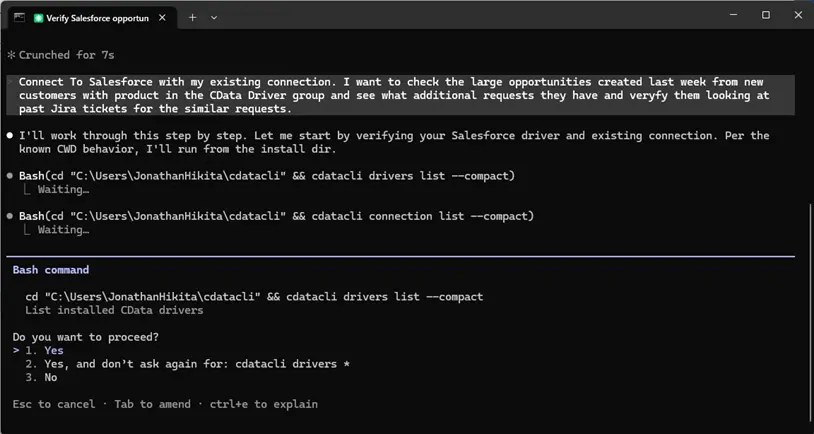
So what is the CData CLI? It's a tool that hands your business data to Claude. You keep talking in plain language. Claude has access to the real data it needs to complete the task—not a summary, not a training snapshot, the live record.
With it, Claude can connect to the real systems your business runs on, like Salesforce, NetSuite, your database, and your support desk, and ask precise questions in the language it already happens to be fluent in. You never type a command. You say "pull the open cases for this account," and it does.
And that single capability changes the kind of assistant you have. Instead of one question and one answer, you get the loop a real operator works in—the same loop that powers Claude Code itself:
Gather. It goes and gets the actual facts from your systems: the real revenue number, the real ticket count, the real contract terms, the history of what you decided before. Not a recollection. The live record.
Act. It works through your method, your skill, grounded in what it just found, and shows you each step as it goes, in the right order, instead of leaping to a verdict.
Verify. Before it stands behind the answer, it checks its own work: stress-tests the plan, pokes holes, surfaces the risk it might have missed. The manager who says "let's make sure this holds before we commit." Not the junior who hands you the first draft as if it were final.
Loop. If verifying turns something up, it goes back, gathers more, and adjusts, landing only when the work actually holds together.
And underneath all of it, it remembers. Claude Code keeps a memory of your company context, your past decisions, and your preferences, so the next session doesn't start from zero. The loop compounds, the way a long-tenured employee does.
Gather, act, verify, loop, with memory underneath. That's not a search box. That's a chief of staff.
A real example
Say a customer asks for a custom contract term your team doesn't normally offer. If you just copy-paste the email from the customer, Claude will provide replies based on the average practice in the industry, without knowing your exact context.
Now imagine you've given Claude an operations-advisor skill—a structured method that clarifies the situation, weighs the options, builds an action plan, and stress-tests it before you act. The kind of method a seasoned operator would use.
On its own, that skill is smart but ungrounded. Connected to your data through the CData CLI, it becomes a twenty-year veteran with the books open in front of them:
It pulls the customer's actual account: business volume, their open opportunities, and their case history.
It checks your internal policy document in Atlassian Confluence or Microsoft SharePoint, so you stay consistent instead of reinventing the policy.
It pulls internal Slack or Microsoft Teams channels, grabs the similar topics, and understands how your company handled them.
Then it runs the analysis (clarify, recommend, plan, test) on real facts, and tells you not just what to do, but what would have to be true to justify it.
That's the difference between advice and counsel. Counsel knows your situation. Now Claude can, too.
Why Claude Code, specifically
This works because of three things Claude Code can do that, together, add up to far more than their parts.
The terminal connects your data, with nothing to build. Normally, connecting AI to business data is a whole project. You build a "RAG" pipeline (copying your data into a special search index the AI can read), or you stand up a server, or you wire together infrastructure someone then has to maintain. With Claude Code, none of that. It already has a terminal, the CData CLI runs inside it, and it queries your live systems directly. No RAG pipeline to build. No custom integration to maintain. The terminal handles the rest.
Skills bring the experience, and the discipline. A skill is your method, written down: the order to think in, the questions to always ask, the steps you're not allowed to skip, the moment to stop and check. It's what turns raw intelligence into a disciplined operator who works the way your best people work—the same way, every time, not a fresh improvisation whenever the mood takes it.
File handling keeps your work. Claude Code reads and writes files, so what it produces doesn't evaporate into a chat window you'll lose track of tomorrow. The analysis, the plan, and the decision record land in real documents you keep and build on. No more copy-paste-and-pray. Nothing you've done gets lost.
Here's the plain truth: data without discipline is a fire hose. Discipline without data is a confident guess. And either one, with nowhere to keep the work, is effort you'll just do again next week. Claude Code is the rare place all three come together, and the CLI is what makes the first one real, without a project to staff or a server to babysit.
"But I'm not technical"
That's the best part: this was built so you don't have to be.
You won't write code or commands. You describe what you want; Claude runs the tool. The command line is its workspace, not yours.
You don't need to know SQL, the language used to ask data questions. Claude already speaks it fluently, better than most engineers. You speak plain English (or Japanese); it translates.
Setup is light. There's no server to stand up or host. When you need a new data source, you connect it once through the CData CLI—a one-time setup, usually just a login in your browser, and Claude handles the querying from there.
It's safe by default. Connections can be read-only, so Claude can look but never change anything. Your credentials stay on your machine, in an encrypted store, and are never handed to the AI.
You stay in charge. Claude just stops guessing.
When you need more control: CData Connect AI The CLI is the fast path for a trusted individual — your machine, your full access, working in minutes. But the moment it's “your team”, a new question may show up: who is allowed to see what?
That's where CData Connect AI comes in — a cloud-based AI data layer service for the same data sources CData Drivers support. Same plain-language experience for you but run as a governed service instead of a tool on your laptop, so it adds what a company needs once more than one person is involved: user-level governance (people sign in as themselves), role-based data access (Claude can only pull what that person is cleared to see), and central control in one place. It speaks MCP, the open protocol Claude uses to talk to managed services.
From chatbot to colleague with CData CLI
The people quietly getting the most out of Claude Code right now aren't the ones asking it cleverer questions. They're the ones who connected it to their real work—their files, their methods, and now their data. They let it gather, act, verify, and remember on their behalf.
You already brought it your files and your playbooks. Bring it your data, and the assistant you've been chatting with becomes the experienced operator you've been wishing for.
You don't have to be a developer. Install the CData CLI, connect your first data source, and give Claude something real to work with.





