







How to Visualize CSV Data in Python with pandas via CData Connect AI

The rich ecosystem of Python modules lets you get to work quickly and integrate your systems more effectively. With the CData Connect AI Python SDK, the pandas and Matplotlib modules, you can build CSV-connected Python applications and scripts for visualizing CSV data. This article shows how to connect to Connect AI and use the pandas and Matplotlib built-in functions to query CSV data and visualize the results.
The Connect AI Python SDK (cdata-connect-ai) is a DB-API 2.0 (PEP 249) compliant client, so pandas can read query results directly from the SDK connection object. There is no driver to install per source and no SQLAlchemy engine to configure: connect with a Personal Access Token and pass the connection straight to pandas.read_sql.
Connect to CSV in Connect AI
CData Connect AI uses a straightforward, point-and-click interface to connect to data sources.
- Log into Connect AI, click Sources, and then click Add Connection
- Select "CSV" from the Add Connection panel
-
Enter the necessary authentication properties to connect to CSV.
Connecting to Local or Cloud-Stored (Box, Google Drive, Amazon S3, SharePoint) CSV Files
CData Drivers let you work with CSV files stored locally and stored in cloud storage services like Box, Amazon S3, Google Drive, or SharePoint, right where they are.
Setting connection properties for local files
Set the URI property to local folder path.
Setting connection properties for files stored in Amazon S3
To connect to CSV file(s) within Amazon S3, set the URI property to the URI of the Bucket and Folder where the intended CSV files exist. In addition, at least set these properties:
- AWSAccessKey: AWS Access Key (username)
- AWSSecretKey: AWS Secret Key
Setting connection properties for files stored in Box
To connect to CSV file(s) within Box, set the URI property to the URI of the folder that includes the intended CSV file(s). Use the OAuth authentication method to connect to Box.
Dropbox
To connect to CSV file(s) within Dropbox, set the URI proprerty to the URI of the folder that includes the intended CSV file(s). Use the OAuth authentication method to connect to Dropbox. Either User Account or Service Account can be used to authenticate.
SharePoint Online (SOAP)
To connect to CSV file(s) within SharePoint with SOAP Schema, set the URI proprerty to the URI of the document library that includes the intended CSV file. Set User, Password, and StorageBaseURL.
SharePoint Online REST
To connect to CSV file(s) within SharePoint with REST Schema, set the URI proprerty to the URI of the document library that includes the intended CSV file. StorageBaseURL is optional. If not set, the driver will use the root drive. OAuth is used to authenticate.
Google Drive
To connect to CSV file(s) within Google Drive, set the URI property to the URI of the folder that includes the intended CSV file(s). Use the OAuth authentication method to connect and set InitiateOAuth to GETANDREFRESH.

- Click Save & Test
- Navigate to the Permissions tab and update the user-based permissions.



Generate a Personal Access Token (PAT)
The Python SDK authenticates to Connect AI with your account email and a Personal Access Token (PAT). It is best practice to create a separate PAT for each application to maintain granularity of access.
- Click the Gear icon () at the top right of the Connect AI app to open the Settings page.
- On the Settings page, go to the Access Tokens section and click Create PAT.
- Give the PAT a name and click Create.

- The PAT is only visible at creation, so copy it and store it securely.
Install Required Modules
Install the SDK (with the pandas extra) and Matplotlib using the pip utility:
pip install "cdata-connect-ai[full]"
pip install matplotlib
Visualize CSV Data in Python
Import the modules, then connect to Connect AI with your account email and PAT. Identifiers are three-part: <Connection>.<Schema>.<Table>, where the connection name defaults to the source name (for example, CSV1).
import pandas
import matplotlib.pyplot as plt
import cdata_connect_ai

conn = cdata_connect_ai.connect(
    username="[email protected]",
    password="<your_pat>",
)
Query CSV with pandas
Use the read_sql function from pandas to execute a SQL statement and store the result set in a DataFrame. Pass the SDK connection directly, no engine required.
df = pandas.read_sql(
    "SELECT City, TotalDue "
    "FROM [CSV1].[CSV].[Customer] "
    "WHERE FirstName = 'Bob'",
    conn,
)
Note: pandas may print a UserWarning stating that it only officially supports SQLAlchemy connectables. This is expected when passing a DB-API connection directly—the query runs correctly and the warning is safe to ignore.
Visualize CSV Data
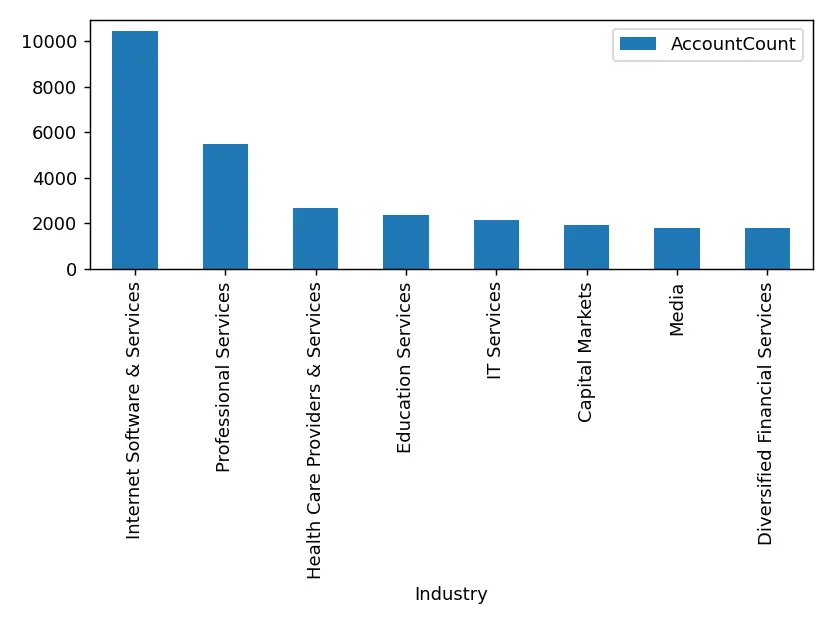
With the query results stored in a DataFrame, use the plot function to build a chart. The show method displays the chart in a new window.
df.plot(kind="bar", x="City", y="TotalDue")
plt.show()

conn.close()
More Information and Free Trial
Now you can read live CSV data into pandas through the CData Connect AI Python SDK. For more information on connecting to CSV (and hundreds of other data sources), visit the Connect AI page. Sign up for a free trial and start working with live CSV data in Python.
Full Source Code
import pandas
import matplotlib.pyplot as plt
import cdata_connect_ai

conn = cdata_connect_ai.connect(
    username="[email protected]",
    password="<your_pat>",
)

df = pandas.read_sql(
    "SELECT City, TotalDue "
    "FROM [CSV1].[CSV].[Customer] "
    "WHERE FirstName = 'Bob'",
    conn,
)

df.plot(kind="bar", x="City", y="TotalDue")
plt.show()

conn.close()